

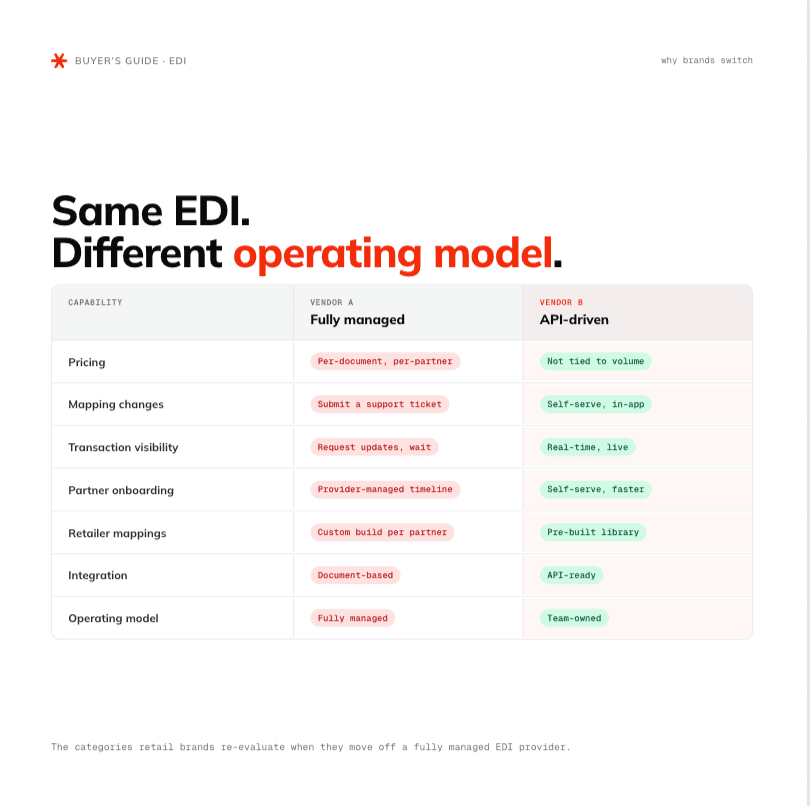
Growing retail brands outgrow SPS Commerce for three consistent reasons: unpredictable costs, slow trading partner onboarding, and a lack of direct visibility into EDI transactions.
SPS Commerce has long been a go-to electronic data interchange (EDI) provider for retail brands, especially those just getting started with retailer integrations. Its managed model and extensive network make it an accessible entry point for companies that want to get up and running without building internal EDI expertise from scratch.
But what works well early on doesn’t always scale. As transaction volume increases, trading partner networks expand, and operational demands become more complex, many brands begin to face limitations in cost, visibility, and control. These challenges don’t always show up immediately, but they become harder to ignore over time.
This article takes an honest look at where growing retail brands begin to outgrow SPS Commerce, what they should consider next when evaluating alternatives, and how a modern EDI approach can help fill these gaps as your transaction volume grows.
Why Most Retail Brands Start With SPS Commerce
Retail brands often choose SPS Commerce because it simplifies the early stages of EDI adoption. When companies need to meet retailer requirements quickly, outsourcing setup and management reduces initial friction.
Large pre-mapped retailer network: SPS Commerce connects to a broad network of retailers, grocers, and distributors, which makes it easier for brands to begin working with established trading partners without building connections from scratch.
Fully managed EDI model: Their managed EDI approach handles mapping, testing, and ongoing maintenance, so internal teams don’t need deep technical expertise to stay compliant.
Retailer familiarity and certifications: Many major retailers are already familiar with SPS Commerce, which can help reduce onboarding complexity and speed up time-to-first transaction.
Lower barrier to entry for new EDI users: For companies new to EDI, outsourcing the technical work allows them to focus on operations while still meeting compliance requirements.
What SPS Commerce Does Well
SPS Commerce remains a strong option for retail brands that prioritize stability and a fully managed EDI solution. Its broad network coverage spans retailers, grocers, and distributors, allowing companies to maintain connections with a wide range of trading partners without building and managing those relationships internally.
The platform also provides ongoing support for retailer-driven changes. When retailers update requirements, SPS Commerce handles the necessary adjustments, which reduces the burden on internal teams and helps maintain compliance across EDI documents.
This model can be a good fit for organizations that prefer to outsource EDI operations entirely. The combination of established retailer certifications, managed services, and a large partner network makes SPS Commerce a dependable choice for teams that value convenience over direct control.
Where Brands Outgrow SPS Commerce
SPS Commerce remains a reliable choice for many organizations, but as retail brands grow, their EDI needs become more complex. What once felt like a convenient, fully managed solution may introduce friction as transaction volume increases and trading partner relationships expand. These challenges typically show up in a few key areas.
Pricing Limitations
SPS Commerce’s pricing model is often based on per-document and per-retailer fees. While that structure can be manageable at lower volumes, it becomes harder to predict as transaction counts grow. Companies may see their EDI costs increase month to month without a clear connection to business outcomes, making it difficult to forecast total cost or control spend over time.
Limited Visibility
As issues arise, many teams find they don’t have direct access to the information needed to diagnose problems quickly. Troubleshooting often depends on submitting a support request and waiting for updates, which can slow down resolution times. Without real-time visibility into EDI documents and errors, it becomes harder to stay ahead of disruptions.
Lack of Control
Making changes to mappings, testing new connections, or onboarding new trading partners typically requires going through SPS Commerce’s team. While that’s part of the managed model, it can create bottlenecks for companies attempting to scale. Teams that need to move quickly may find it difficult to adapt their EDI setup without delays.
Signals That You've Outgrown Your EDI Provider
As limitations build, the impact becomes more visible across day-to-day operations. Many teams don’t immediately connect these issues to their EDI provider, but the signs tend to appear in consistent, measurable ways.
EDI costs fluctuate: When pricing is tied to document volume and trading partner activity, costs can become unpredictable, making it harder to forecast and manage total EDI spend.
New trading partner onboarding timelines: Onboarding new retailers or distributors may require multiple touchpoints, extended timelines, and ongoing coordination, which can slow down growth initiatives.
Reliance on support for basic visibility: If your team needs to submit tickets just to understand what’s happening within a transaction, troubleshooting slows and becomes more dependent on external response times.
Teams scaling faster than systems: As internal operations grow, a lack of flexibility in your EDI setup can create friction between teams that need to move quickly and systems that can’t keep up.
Missed opportunities due to onboarding delays: When new trading partner connections take too long to establish, companies may lose out on potential revenue simply because they can’t meet partner requirements fast enough.
Why Brands Switch EDI Providers
When these challenges begin to impact day-to-day operations, many companies start evaluating whether their current EDI solution still supports long-term growth. The decision to switch EDI providers is rarely driven by a single issue. It’s usually the result of common pain points that compound over time.
What they stop tolerating: Companies often cite pricing unpredictability, slow onboarding timelines, and delays caused by support-dependent processes as key reasons for switching. As these issues become more frequent, teams begin to look for alternatives that offer more consistency and ownership over their processes.
What improves after switching: Many brands report faster onboarding, greater visibility into EDI transactions, and more predictable pricing models. These changes can reduce operational bottlenecks and give internal teams more confidence in their ability to scale.
How evaluation decisions are made: When comparing providers, factors such as total cost, transparent pricing, onboarding speed, and ease of integration often outweigh brand familiarity. This is often where newer EDI platforms stand out against traditional managed solutions.
Who Should Stay on SPS Commerce
Not every organization needs to switch EDI providers. For some retail brands, SPS Commerce continues to be a practical and effective solution, especially when their needs align with a fully managed model.
Preference for a fully managed approach: Suppliers that don’t want to manage EDI internally may benefit from outsourcing setup, maintenance, and support to a managed service provider.
Stable trading partner network: If your list of trading partners isn’t growing quickly, the limitations around onboarding speed and flexibility may not create immediate challenges.
Limited internal technical resources: Teams without dedicated integration or IT support may find it easier to rely on an external provider than to build in-house EDI capabilities.
What to Look for When Evaluating a Modern EDI Alternative
When retail brands begin evaluating an SPS Commerce alternative, the focus often shifts from simply maintaining EDI compliance to improving efficiency, control, and long-term scalability. The right EDI solution should support both current requirements and future growth without introducing new limitations.
Predictable pricing models: Look for transparent pricing that isn’t tied directly to document volume or the number of trading partners. This makes it easier to forecast EDI costs and avoid unexpected increases as your business scales.
Self-serve onboarding capabilities: The ability to onboard new trading partners without relying on support tickets can significantly reduce onboarding timelines and help your team move faster.
Real-time transaction visibility: Access to live transaction data allows teams to identify and resolve issues quickly without waiting on external support.
Pre-built retailer mappings: Pre-configured mappings for major retailers can streamline implementation and reduce the effort required to establish new connections.
API-ready integration path: A platform that supports API integration provides flexibility for companies that want deeper system connectivity with their ERP, WMS, or other business systems over time.
Choose the Right SPS Commerce Alternative for Your Business
Choosing the right SPS Commerce alternative comes down to how well a platform can support your growth without introducing new constraints. As new trading partner connections are added and transaction volumes increase, retail brands need an EDI solution that offers predictable pricing, real-time visibility, and the flexibility to adapt quickly.
Orderful’s API-driven EDI platform, Mosaic, is designed to give teams more control over their integrations. With easy partner onboarding, no hidden costs, and clear visibility into every transaction, companies can build a more scalable, efficient EDI foundation rather than work around limitations.
If you’re evaluating your options, now is the time to see what a modern approach can offer. Book a demo to explore how Orderful can support your next stage of growth.
Frequently Asked Questions
Why Do Retail Brands Replace SPS Commerce?
Retail brands typically replace SPS Commerce when rising transaction volumes make per-document pricing unpredictable, onboarding new trading partners takes too long, or teams lack direct visibility into EDI errors. As operational complexity grows, the managed model can create bottlenecks that slow down scaling.
What Are the Main Limitations of SPS Commerce?
The main limitations of SPS Commerce include per-document and per-retailer pricing that becomes hard to forecast at scale, limited real-time visibility into transactions, and reliance on support tickets to make mapping changes or onboard new trading partners — all of which can slow growing operations.
What Should I Look for in an SPS Commerce Alternative?
Look for predictable flat-rate pricing, self-serve trading partner onboarding, real-time transaction visibility, pre-built retailer mappings, and an API-ready integration path. Platforms like Orderful are built to give retail brands more control and transparency than traditional managed EDI solutions.
Who Should Stay on SPS Commerce?
SPS Commerce is a solid fit for brands that prefer a fully managed EDI model, have a stable trading partner network that isn't growing quickly, or lack internal technical resources to manage integrations. If those conditions apply, the limitations around control and pricing are less likely to cause friction.
How Long Does It Take To Onboard With a Modern EDI Platform?
Modern API-first EDI platforms can significantly reduce onboarding timelines compared to traditional managed providers. Orderful customers average nine days to onboard a new trading partner, compared to the multi-week timelines common with legacy EDI setups.
- 01Why Most Retail Brands Start With SPS Commerce
- 02What SPS Commerce Does Well
- 03Where Brands Outgrow SPS Commerce
- 04Signals That You've Outgrown Your EDI Provider
- 05Why Brands Switch EDI Providers
- 06Who Should Stay on SPS Commerce
- 07What to Look for When Evaluating a Modern EDI Alternative
- 08Choose the Right SPS Commerce Alternative for Your Business
- 09 Frequently Asked Questions
