

EDI often costs more than expected because legacy pricing models charge per transaction, per kilocharacter, or per VAN mailbox, so the bill grows every time order volume grows, even when nothing else has changed. Orderful prices EDI by trading partner instead of by document, so costs stay predictable as transaction volume increases. The most cost-effective EDI provider is the one whose pricing is easiest to forecast, not the one with the lowest starting price.
Electronic data interchange (EDI) has always been a business-critical way to exchange orders, invoices, shipping notices, and other documents between trading partners. But for many companies, EDI costs have become difficult to understand and even harder to predict. A quote that looks reasonable at first can balloon quickly once hidden fees, support charges, and setup costs are factored in.
That’s why many buyers start looking for low-cost EDI solutions when what they really need is a modern EDI platform with easy-to-understand pricing and fewer surprises. Orderful takes a different approach: instead of charging by document, character, or usage, our pricing is based on the number of active trading partners in your network, so the bill doesn't rise every time your business processes more orders with the same partners. The goal isn't to find the cheapest provider. It's about finding EDI pricing that supports growth without turning every new document or trading partner into an unexpected cost. This article explains why EDI often costs more than it should and how a fairer, partner-based pricing model can reduce your overall spending over time.
Why Is Traditional EDI Pricing Designed to Scale Against You?
Traditional EDI pricing models often look manageable when a company has a small number of trading partners or a predictable monthly document volume. However, many legacy models are built around variables that increase as the business grows. More purchase orders, more invoices, larger files, and new business partners can all raise the cost of EDI even when the underlying workflow hasn’t changed much.
Per-Transaction and Kilocharacter Fees
Some EDI providers charge transaction fees for each EDI document sent or received. A purchase order, invoice, or advance ship notice may each create a separate charge. Other pricing models add kilocharacter fees based on the volume of data moving through the system. That means a larger document can cost more than a smaller one, even if both support the same business process.
EDI VAN fees can add another layer. Value-added networks were built to route EDI documents between businesses, but some VANs still charge access fees based on mailbox usage, data volume, minimum record lengths, or overage fees. When those costs stack on top of the base subscription, they can make the monthly bill difficult to forecast.
Hidden Costs: Support, Archive Access, and Partner Onboarding
The visible price is only part of the true cost. Some providers charge extra for support tickets, document archive access, mapping changes, or trading partner onboarding. These hidden costs often appear after implementation, when switching providers is harder, and the business already depends on the system.
That structure can make normal growth feel expensive. A company that adds new trading partners, increases order volume, or needs help resolving document errors may see costs rise for reasons that aren’t obvious in the original quote. Over time, those additional costs can make traditional EDI more expensive than expected.
What Does Low-Cost EDI Actually Means (and What It Doesn’t)?
Low-cost EDI doesn’t mean stripped-down EDI, limited visibility, or support that disappears after implementation. It means the provider’s pricing model is easier to understand before you sign and easier to forecast as your business grows.
That distinction matters because affordable EDI software can still include the functionality that companies of any size — from small and mid-sized businesses to enterprise-scale organizations — need to stay compliant and exchange documents reliably. The real question is whether the pricing is built around predictable value or unpredictable usage. A low monthly entry price may look appealing, but it can become expensive once hidden costs, ongoing fees, and support charges start to accumulate.
A better description would be cost-effective EDI, meaning the software reduces unnecessary spending without compromising service quality. Predictable EDI pricing should make it clear what’s included, what costs extra, and how your bill may change as transaction volume, trading partners, or data access needs increase.
For most businesses, the right solution isn't the cheapest EDI provider. It's the provider that makes the long-term cost easiest to understand, which is why we built Orderful's pricing around trading partners instead of transaction volume.
What Does a Fair EDI Pricing Model Looks Like?
An EDI pricing model should be clear before implementation starts and stable enough to support growth after the system goes live. Buyers should be able to understand the flat monthly fee, setup costs, trading partner fees, support coverage, and any conditions that may change the bill later.
That’s where partner-based pricing can make EDI forecasting easier. Instead of tying the total cost to every document, character, or transaction, partner-based pricing connects cost to the number of active trading partners in the network. For companies with growing transaction volume, that model can be easier to plan around because the bill doesn’t rise every time the business processes more documents with the same partner.
Why Partner-Based Pricing Is Easier to Forecast
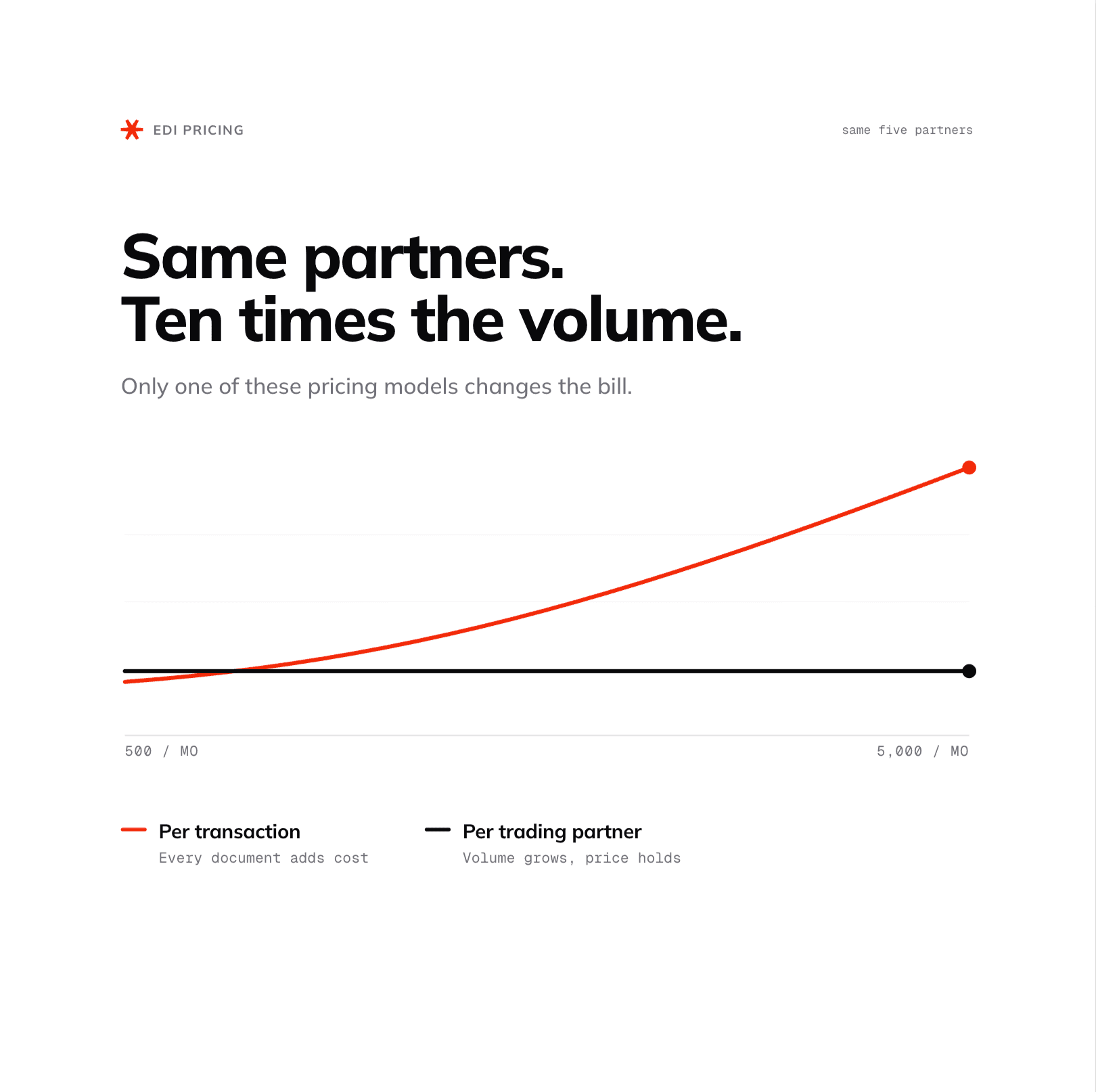
In a hypothetical example, one company might exchange 500 EDI transactions per month with five trading partners. Later, order volume grows, and that same company exchanges 5,000 transactions per month with those same five partners. Under a per-transaction model, the total cost may rise sharply because the company is charged for each additional EDI transaction. Under a per-trading-partner model, the core pricing driver is tied to the five partner relationships, not to every document that moves through them.
Pricing Model | Cost Driver | What Happens as Volume Grows |
|---|---|---|
Per-transaction | Each document sent or received | Bill rises with every additional order, invoice, or ASN |
Kilocharacter-based | Size of each document | Larger files cost more, even for the same process |
VAN mailbox/access fees | Mailbox usage, data volume, overage | Adds a second layer of unpredictable cost on top of the base fee |
Partner-based (Orderful) | Number of active trading partners | Cost stays tied to partner relationships, not transaction volume |
Orderful’s pricing approach helps companies avoid unpredictable per-document and overage fees through transparent models built around trading relationships rather than transaction volume. The Mosaic platform supports API-driven EDI for companies that want to connect EDI directly into internal systems, while Orderful's Pixel web EDI solution gives teams a web-based way to manage EDI workflows without heavy infrastructure. Together, they support predictable costs without forcing buyers into a bare-bones solution.
How Do You Evaluate the Total Cost of Ownership Before Signing Anything?
Before choosing an EDI provider, look past the advertised monthly rate and evaluate the total cost of ownership. The true EDI cost includes implementation costs, ongoing maintenance, internal resources, and additional fees that may arise after the system is running.
A provider that looks affordable upfront may become expensive if every change, question, or new trading partner creates another charge. These steps will help ensure that you know what you're paying for and how much it might cost:
Ask what’s included: Confirm whether the quoted price includes setup fees, software licenses, data access, archive access, and basic support. If those items are separate, the advertised price may not reflect the true EDI cost.
Check how transaction volume affects price: Ask whether transaction volume, document size, or EDI usage can trigger overage fees. This helps you compare providers based on growth scenarios rather than just today’s document volume.
Clarify onboarding and mapping costs: New trading partners often require setup, testing, and mapping work. Make sure you know whether onboarding fees and mapping fees are included, limited, or billed separately.
Review support and archive access: Support charges can add up if every ticket creates a billable event. Archive access can also matter when teams need to research old documents or resolve customer disputes.
Compare long-term costs: Look at the annual fee, ongoing fees, and maintenance costs together.
The most cost-effective provider is usually the one with predictable costs, not the one with the lowest starting price. Taking these steps helps prevent surprises on your monthly invoice.
Predictable EDI Pricing Helps Control the True Cost of EDI
The true cost of EDI shouldn’t be a moving target. If pricing depends on every document, support request, data volume change, or new partner connection, it becomes harder to plan for growth with confidence.
Orderful gives companies a more predictable way to manage EDI costs through transparent per-trading-partner pricing, modern workflows, and flexible solutions tailored to different operational needs. When the pricing model is easier to understand, organizations can budget more accurately and scale without bracing for surprise charges or fluctuating ongoing costs. See how Orderful pricing helps make EDI bills easier to understand before costs start to scale.
EDI Pricing FAQs
Why does EDI cost more than expected?
EDI often costs more than expected because legacy pricing models charge per transaction, per kilocharacter, or through VAN access fees, so costs rise as order volume grows even when the underlying workflow hasn't changed. Hidden fees for support, archive access, and partner onboarding can also appear after implementation.
What is partner-based EDI pricing?
Partner-based EDI pricing ties the cost of an EDI platform to the number of active trading partners in a company's network rather than the number of documents or transactions exchanged. This makes costs easier to forecast because the bill doesn't rise every time transaction volume increases with the same partners.
Is the cheapest EDI provider the best option?
Not usually. The cheapest EDI provider can become expensive if per-document fees, overage charges, or hidden costs for support and onboarding accumulate over time. The most cost-effective provider is typically the one with the most predictable pricing, not the lowest advertised rate.
What hidden costs should I look for in an EDI quote?
Common hidden EDI costs include support ticket fees, document archive access charges, mapping or onboarding fees for new trading partners, and VAN overage fees. Ask providers directly whether these are included in the base price or billed separately before signing.
- 01Why Is Traditional EDI Pricing Designed to Scale Against You?
- 02What Does Low-Cost EDI Actually Means (and What It Doesn’t)?
- 03What Does a Fair EDI Pricing Model Looks Like?
- 04How Do You Evaluate the Total Cost of Ownership Before Signing Anything?
- 05Predictable EDI Pricing Helps Control the True Cost of EDI
- 06EDI Pricing FAQs
