
.jpg&w=2048&q=75)
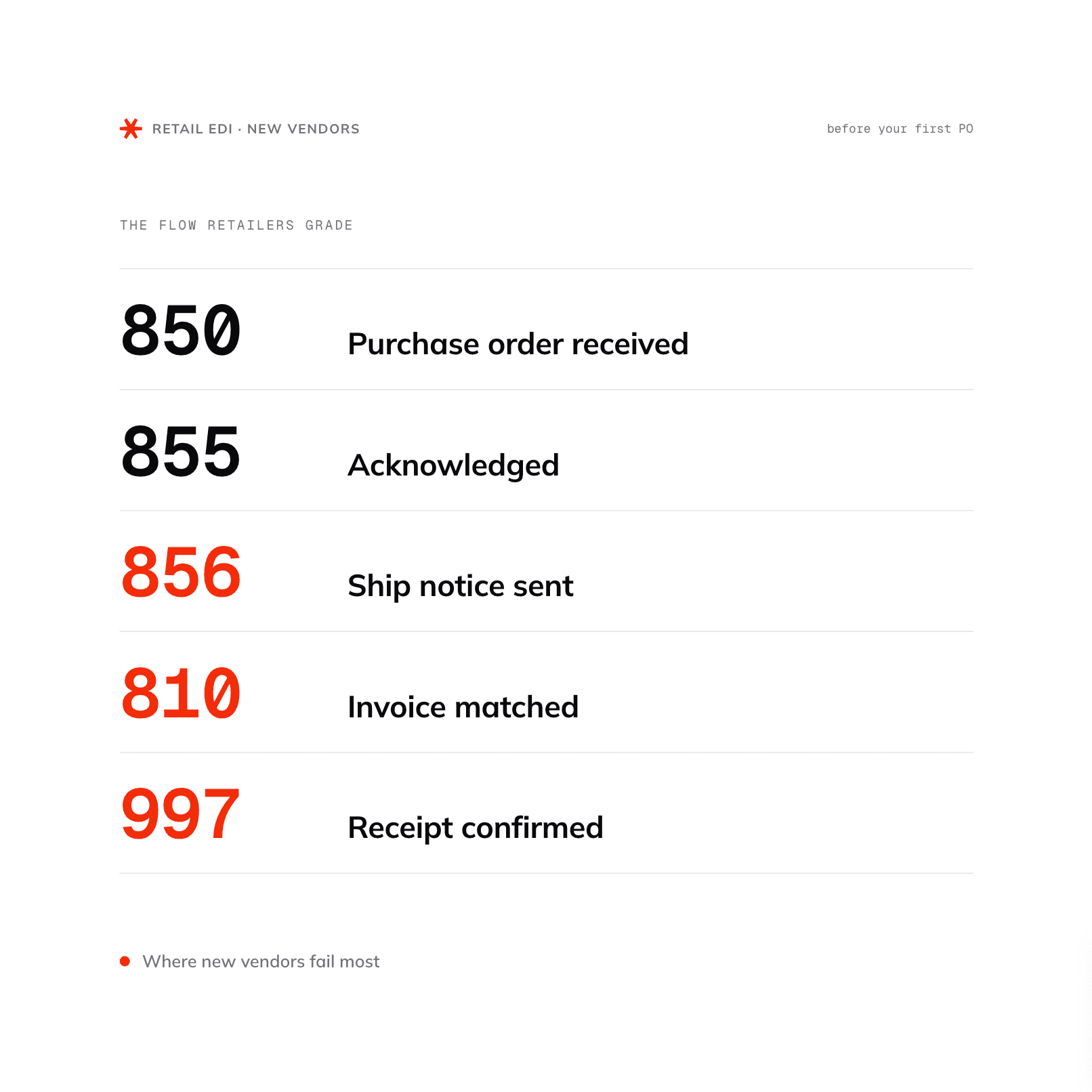
Having an EDI connection isn't the same as being EDI compliant. Retailers enforce document timing, formatting, and accuracy at every step, especially ASNs, invoices, and 997 acknowledgments. Requirements also differ by retailer, so passing one retailer's testing doesn't guarantee compliance with another.
Getting set up for electronic data interchange (EDI) is only the first step in becoming a retail-ready vendor. Once the connection exists, retailers still expect every transaction to follow precise rules for timing, formatting, accuracy, and confirmation.
The real test begins when a retailer starts measuring whether each document is correct, complete, and on time. A vendor may be able to receive a purchase order and send electronic documents back, but that doesn’t always mean they'll pass testing or meet operational standards. Before their first purchase order arrives, new vendors need to know which EDI requirements retailers enforce and where compliance failures most often occur. This article explains what to expect before receiving your first retail purchase order and how a modern EDI solution can help you meet and maintain EDI compliance.
EDI Connectivity and EDI Compliance Are Not the Same Thing
A working EDI connection — or EDI connectivity — means a vendor can exchange business documents with a retailer. Retail EDI compliance goes further. It means each EDI transaction follows the retailer’s exact rules for document format, expected fields, timing, testing, and confirmation.
That difference matters because major retailers don’t evaluate vendors solely on whether data can be moved from one system to another. They evaluate whether data flows correctly through the full EDI process. A purchase order has to be received, acknowledged, fulfilled, shipped, invoiced, and confirmed according to the retailer’s trading partner rules. If one step is late, incomplete, or formatted incorrectly, the vendor may not be fully compliant regardless of their connectivity.
What Retailer EDI Requirements Actually Enforce
Retailer EDI requirements usually focus on whether each document supports a real operational step. Retailers need to know when a vendor received the order, what they're shipping, how they packed the cartons, where the shipment is going, and whether invoice data matches the original purchase order. For new vendors, compliance issues often appear when the EDI system sends the right document type but the wrong details. A technically valid file can still fail if the shipment data, timing, labels, or acknowledgments don’t match the retailer’s rules.
The EDI 856 ASN: the Most Chargeback-Prone Document in Retail
The advance ship notice (ASN) is often the most closely enforced EDI document because it tells the retailer what to expect before the shipment reaches the distribution center. Major retailers use the 856 ASN to plan receiving, scan cartons, verify labels, and compare shipments against purchase orders. If the notice is late, missing, or inaccurate, the retailer may not be able to process the delivery properly. Walmart supplier guidance commonly points to sending the ASN within 30 minutes of dispatch, while Kohl’s guidance ties compliance performance to a goal of keeping non-compliance below 0.7% of cost receipts.
Invoice Accuracy and the 3-Way Match
Accurate invoices matter because the EDI 810 invoice, EDI 850 purchase order, and EDI 856 ASN usually have to match in three ways. Retailers compare quantities, prices, item numbers, shipment details, and other invoice data before approving payment. When those documents don’t line up, companies can face delayed payments, manual review, deductions, or disputes. For new vendors, the safest approach is to generate invoices directly from the same order and shipment data used earlier in the EDI process.
The 997 Functional Acknowledgment: the Silent Compliance Gap
The 997 functional acknowledgment doesn’t confirm that an order is correct or that a shipment is ready. It verifies that an EDI document was received and accepted or rejected at the transaction level. That makes it easy to overlook, but it’s a critical compliance signal. If a vendor sends an invoice, ASN, or purchase order acknowledgment and doesn’t monitor their 997 acknowledgments, they may not know a document failed until a chargeback, delayed payment, or missed fulfillment step appears later.
What Non-Compliance Costs New Vendors
Not being EDI compliant with retailers can affect new vendors before business relationships have time to stabilize. Retail chargebacks are the most visible cost, but they aren’t the only one. A missed ship notice, incorrect label, rejected invoice, or unresolved acknowledgment can also lead to delayed payments, manual corrections, shipment exceptions, and strained relationships with retail partners.
For new vendors, these problems can be especially painful because early orders often set the tone for future volume. If a retailer sees recurring compliance issues, the vendor may have to spend more time proving operational reliability instead of focusing on growth. The goal isn’t only to avoid a single retail compliance penalty. It’s to show that the vendor can consistently meet the trading partner rules once purchase orders begin moving.
Why the Same EDI Requirements Don’t Apply to Every Retailer
Passing EDI testing with one retailer doesn’t guarantee a vendor will meet the same expectations elsewhere. Retailers may use the same core EDI transaction sets, but each trading partner can define its own rules for required fields, ship windows, carton labels, acknowledgment timing, invoice matching, and chargeback enforcement.
That variation is where many new vendors get caught. One retailer may accept certain shipment details, while another may require a different field, label format, or a different timing window altogether. A vendor agreement may also define compliance penalties differently by retailer, even when the EDI documents look similar. Staying compliant means treating each retail partner's requirements as its own rule set, not as a one-time certification process.
EDI Compliance Checklist: What Ready Looks Like Before Your First PO
After receiving your first EDI request and before the first retail PO arrives, new vendors should confirm that their EDI infrastructure can support the retailer’s day-to-day compliance expectations, not just the initial connection.
A compliance-ready setup should include:
Required EDI transaction sets: The vendor can receive, send, and monitor every required document, including purchase orders, ship notices, invoices, and acknowledgments.
Shipment data validation: The vendor can verify carton details, quantities, labels, carrier information, and delivery data before the ASN is sent.
Testing and certification: Sample transactions have passed the retailer’s testing process before live orders begin.
Transaction status visibility: The team can see whether EDI documents have been received, accepted, rejected, or are still awaiting correction.
ERP or fulfillment system readiness: Order, shipment, and invoice data flows correctly between the EDI solution and internal business processes.
Build Retail EDI Compliance Before the First PO Arrives
Retail EDI compliance is easier to manage before orders start moving than after chargebacks, rejected documents, or delayed payments appear. For new vendors, readiness means knowing which EDI documents retailers enforce, validating shipment and invoice data, monitoring acknowledgments, and keeping each retailer’s rules visible before the first purchase order arrives.
Orderful Pixel gives vendors a faster path to compliance when they need to meet retailer compliance standards quickly. Orderful's API-driven Mosaic platform supports ERP-connected vendors that need scalable EDI infrastructure across trading partners, systems, and transaction volume.
EDI Compliance for New Vendors FAQs
What does retail EDI compliance mean for new vendors?
Retail EDI compliance means a vendor can meet each retailer’s rules for exchanging necessary EDI documents. That includes sending accurate transaction data, meeting timing requirements, passing EDI testing, monitoring acknowledgments, and following trading partner rules after the connection is live.
Which EDI documents are most important before the first retail purchase order?
The most important EDI documents for most retailers include the EDI 850 purchase order, EDI 855 purchase order acknowledgment, EDI 856 ASN, EDI 810 invoice, and EDI 997 functional acknowledgment. Retailers may also require specific shipping label formats, inventory updates, or other transaction sets depending on the vendor agreement.
Can a vendor be EDI compliant with one retailer but not another?
Yes. A vendor can be compliant with one retailer and still fail another retailer’s standards. Each retailer can define its own required fields, document timing, testing steps, label rules, acknowledgment expectations, and compliance penalties.
- 01EDI Connectivity and EDI Compliance Are Not the Same Thing
- 02What Retailer EDI Requirements Actually Enforce
- 03What Non-Compliance Costs New Vendors
- 04Why the Same EDI Requirements Don’t Apply to Every Retailer
- 05EDI Compliance Checklist: What Ready Looks Like Before Your First PO
- 06Build Retail EDI Compliance Before the First PO Arrives
- 07EDI Compliance for New Vendors FAQs
