

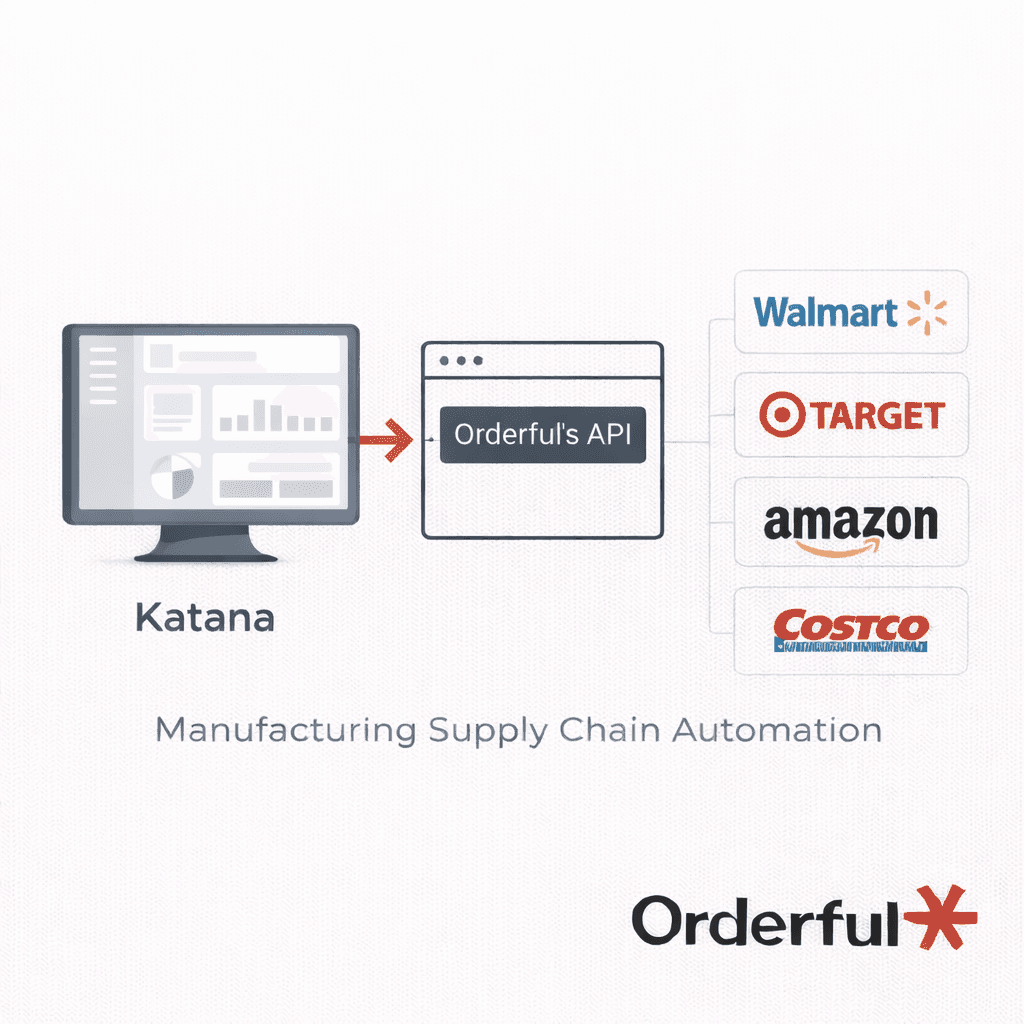
Automate your manufacturing supply chain with Katana EDI integration. Learn how Orderful connects to retail partners and streamlines supply chain workflows.
Katana EDI integration connects Katana Cloud Inventory to retail trading partners like Walmart, Target, and Amazon through Orderful’s API-driven network, automating purchase orders, invoices, and inventory updates so manufacturers can streamline operations, maintain compliance, and scale without manual processes.
Katana Cloud Inventory gives manufacturers powerful tools for production planning, batch tracking, and inventory management. But when it comes to retail compliance, Katana alone isn’t enough. Large retailers like Costco require electronic data interchange (EDI) to share purchase orders, ASNs, and invoices in standardized formats with suppliers and logistics partners.
Without a direct connection between systems, teams often rely on manual data entry or legacy managed services that slow down business processes. A modern, API-first approach to EDI connects Katana directly to retail trading partners, reducing human error and providing real-time visibility across your supply chain.
About Orderful
Orderful's Mosaic platform connects Katana Cloud Inventory to retail trading partners through API-driven integration automating purchase orders, ASNs, and invoices without manual data entry. The platform handles retailer-specific mapping requirements once and reuses them across future partners, supports testing and validation before go-live, and enables nine-day average onboarding compared to months-long legacy timelines. Flat per-partner pricing eliminates unpredictable transaction fees while real-time visibility tracks every document from purchase order through invoice.
Why Connect Katana Cloud Inventory to Orderful?
Katana Cloud Inventory doesn’t include native EDI connectivity to retail trading partners, leaving manufacturers to rely on a specialized platform to automate transactions and maintain compliance at scale. Connecting Katana to Orderful bridges that gap by linking your manufacturing system directly to retailers like Walmart, Target, Amazon, and Costco through a single API-driven network.
Traditional managed services and VAN-based models often rely on manual oversight, custom integrations, and transaction-based pricing. A modern, API-first EDI platform changes that dynamic.
Here’s how they compare:
Manual processes vs. automation: Legacy setups often require teams to rekey purchase orders or upload invoice files manually, increasing the risk of human error and staffing costs. With an API-driven integration between Katana and Orderful, sales orders, ASNs, and invoices flow automatically between systems.
Managed services vs. API-driven EDI: Traditional providers act as intermediaries, which can slow trading partner updates and limit visibility. Orderful’s API-driven Mosaic connects Katana directly to your retail trading partners, giving you real-time visibility into every transaction.
Transaction fees vs. predictable pricing: Many legacy providers charge per document, creating unpredictable EDI costs as you grow. A flat, predictable, per-partner pricing model supports operational efficiency and helps you scale without a hidden transaction “tax.”
Months-long onboarding vs. rapid partner setup: Onboarding new partners through managed services can take months. With standardized connections and reusable mappings, manufacturers can go live in days, not quarters.
By connecting Katana to Orderful, your entire business gains streamlined operations, stronger compliance, and the flexibility to support new retail partnerships without adding in-house overhead.
Key EDI Transactions For Katana Users
Retail compliance depends on a specific set of EDI transactions flowing accurately between Katana Cloud Inventory, Orderful’s API-driven network, and your retail trading partners. Each document plays a defined role in the supply chain, and even small errors can disrupt order management, delay shipments, or trigger chargebacks. When these transactions move automatically, manufacturers eliminate manual processes, protect margins, and maintain optimal inventory levels.
Purchase Orders (850) → Automate Katana Sales Orders
Retailers like Walmart, Target, Amazon, and Costco send electronic purchase orders (POs) that must be processed quickly and accurately. With a direct integration, incoming purchase orders flow straight into Katana as sales orders, eliminating manual data entry and reducing human error.
Instead of rekeying line items or uploading flat files, your order management process becomes automated and traceable from the start. That means faster confirmations, fewer discrepancies, and real-time visibility into demand across your ecommerce operations and retail channels. As order volume grows, automation prevents staffing costs from rising at the same pace.
ASN (856) → Ship With Confidence
Retailers require an accurate advance ship notice (ASN) before shipments arrive at their distribution centers. When Katana triggers fulfillment, shipment details flow through Mosaic automatically, ensuring compliance with retailer formatting requirements and timing expectations.
This process also supports UCC-128 shipping labels, helping manufacturers avoid costly chargebacks and reduce delays caused by incorrect data, labeling errors, or missing shipment details.
Invoice (810) → Close The Order-To-Cash Process
After goods ship, retailers expect a compliant invoice. An automated integration ensures invoice data aligns with the original purchase order and ASN, reducing disputes and payment delays.
If invoices fail validation or contain mismatched data, companies often don’t realize it until revenue is already delayed. Automating invoice transmission strengthens the entire order-to-cash process, improves cash flow predictability, and reduces time spent reconciling exceptions.
Inventory Sync (846) → Maintain Optimal Inventory Levels
Retailers may also require inventory updates through the 846 transaction to maintain real-time inventory management. When Katana syncs inventory levels through Orderful's Mosaic, trading partners receive accurate stock information, preventing overselling and protecting customer experience.
This visibility supports better inventory tracking, more confident production planning, and smoother ecommerce fulfillment as your manufacturing company scales. Instead of reacting to stock discrepancies, teams can focus on maintaining optimal inventory levels across every channel.
Step-By-Step: How The Orderful + Katana Integration Works
The connection between Katana Cloud Inventory and Orderful’s Mosaic is designed to be straightforward, repeatable, and scalable. Instead of building custom integrations for every trading partner, manufacturers connect once and reuse that foundation across their retail network.
Here’s what the process looks like:
Step 1: Connect Katana Via API Integration
Katana integrates with Orderful via a secure API, enabling EDI documents such as sales orders, fulfillment data, invoices, and inventory updates to flow automatically between systems. This creates a real-time data bridge between your manufacturing management platform and your retail trading partners.
Step 2: Map Trading Partner Requirements Once
Retailers may follow standards like ANSI X12 or EDIFACT, but each partner has unique specifications. Orderful handles the mapping layer so your internal Katana data aligns with each retailer’s required format. Once configured, you can reuse those mappings for future trading partners with similar requirements.
Step 3: Test and Validate Transactions
Before going live, transactions are tested and validated to ensure compliance with retailer business requirements. This reduces rejected documents, prevents costly delays, and builds confidence before production traffic begins.
Step 4: Go Live and Onboard New Partners Quickly
With the core integration in place, onboarding new retail partners becomes faster and more predictable. Instead of starting from scratch, manufacturers extend their existing connection, supporting business agility as their ecommerce and retail operations grow.
Modernize Your Manufacturing EDI Automation
Manufacturing EDI automation shouldn’t require an in-house team to manage custom integrations or troubleshoot rejected documents. By connecting Katana Cloud Inventory to Orderful’s API-driven Mosaic platform, manufacturers gain a scalable foundation that supports retail compliance, ecommerce growth, and operational efficiency without increasing staffing costs.
Instead of reacting to manual data errors or unpredictable transaction fees, your team can focus on production, fulfillment, and customer relationships. As new retail partners come online, your integration scales alongside them, supporting long-term business agility and sustainable growth across your entire supply chain.
If you're ready to simplify retail EDI compliance for Katana and future-proof your manufacturing operations, now is the time to act. Talk to an EDI expert or book a demo today to see how Orderful can support your growth.
Katana EDI Integration FAQs
Does Katana have native EDI?
No, Katana Cloud Inventory does not include native EDI connectivity. Manufacturers must integrate with a specialized EDI provider like Orderful to exchange purchase orders, ASNs, invoices, and inventory updates with retailers like Walmart, Target, Amazon, and Costco in required formats.
Why connect Katana to Orderful?
Connecting Katana to Orderful automates sales orders, ASNs, and invoices between systems through a single API-driven network. This eliminates manual data entry, provides real-time visibility, uses flat per-partner pricing instead of unpredictable transaction fees, and enables partner onboarding in days instead of months.
What EDI transactions are critical for Katana users?
Critical transactions include purchase orders (850) flowing into Katana as sales orders automatically, advance ship notices (856) transmitting shipment details for compliance, invoices (810) aligning with purchase orders to reduce payment delays, and inventory sync (846) maintaining real-time stock levels to prevent overselling.
How long does Katana EDI integration take?
Katana EDI integration through Orderful takes an average of nine days. Reusable mappings and standardized connections mean manufacturers don't rebuild integrations for each retailer, enabling faster partner onboarding compared to months-long traditional implementations.
