

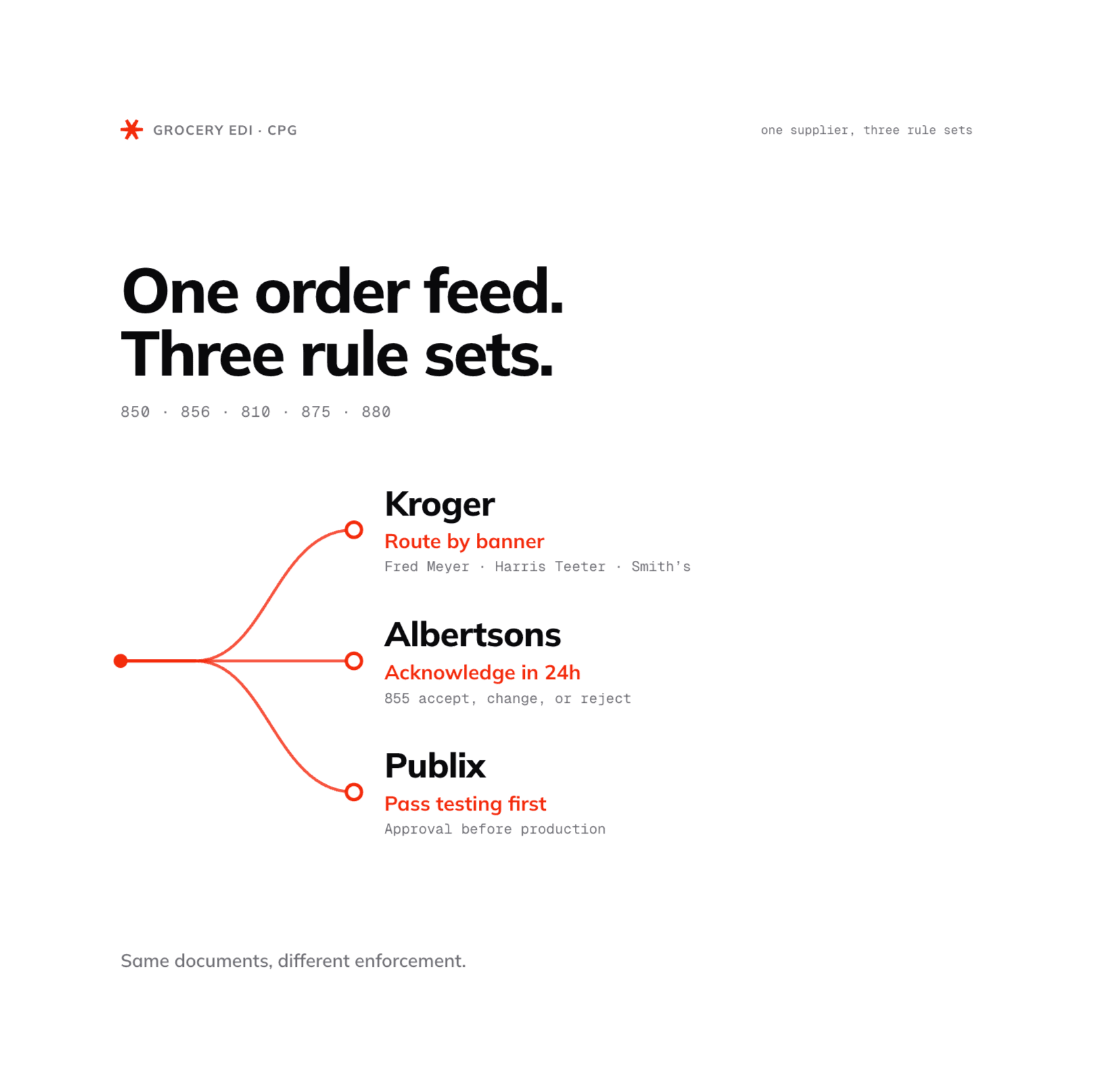
Kroger, Albertsons, and Publix each enforce grocery EDI differently, with distinct timelines, transaction sets, and testing requirements.
For consumer packaged goods (CPG) brands moving into grocery retail, electronic data interchange (EDI) can be more specific than workflows they may have used with mass retailers, distributors, or direct-to-consumer (DTC) fulfillment partners in the past. Grocery EDI requirements often include familiar documents such as purchase orders, advanced ship notices, invoices, and acknowledgments. But many grocery retailers also use transaction sets built specifically for grocery workflows.
That difference matters because Kroger, Albertsons, and Publix each enforce EDI compliance in different ways. A supplier may need to manage banner-specific routing, short acknowledgment timelines, ASN data requirements, or parallel testing before full production. This article explains the grocery EDI requirements CPG brands need to understand when onboarding with Kroger, Albertsons, or Publix and explores how a modern EDI solution can help your organization meet retailer expectations for CPG supply chains.
How Grocery EDI Differs From General Retail EDI
Grocery EDI has to support a faster, more detail-heavy supply chain than many general retail workflows. First, timeliness is a top priority. Perishable goods and expiration dates mean stores need to get those items on their shelves as soon as possible.
Grocery retailers also need to see item details, unit price, shipment details, store or distribution center routing, and data elements tied to shipped goods, all moving accurately between the buyer and supplier. For CPG brands, that means EDI documents can carry more operational weight than standard order processing paperwork.
Grocery-Specific Transaction Sets: 875, 880, 894, 895
Many retailers use the EDI 850 purchase order and EDI 810 invoice, but grocery suppliers may also encounter documents created specifically for the grocery industry. The EDI 875 grocery products purchase order supports purchase order data specific to food and beverage products, while the EDI 880 grocery products invoice supports the invoicing process for food retail workflows. The 894 delivery/return base record and 895 delivery/return acknowledgment can also appear in grocery workflows involving deliveries, returns, or acknowledgments.
Why the 856 ASN Is Still the Most Enforced Document
Even when grocery-specific transaction sets apply, the EDI 856 advanced ship notice (ASN) is often one of the most closely enforced documents. It tells the retailer what shipped, how it was packed, when it moved, and where it’s going. For grocery products, the ASN may also need lot numbers, expiration dates, and other shipment details that support receiving, inventory accuracy, and standards adherence.
Kroger EDI Requirements
Kroger EDI requirements can be especially complex because suppliers may work across Kroger-operated stores, Kroger-owned banners, and different regional or distribution workflows. A CPG brand may not be managing one generic Kroger setup.
EDI timelines and compliance expectations can vary by Kroger program, document type, and connection method. Depending on the banner, division, product category, and fulfillment model, a supplier may need to route EDI transactions correctly for Kroger-named stores, Fred Meyer, Harris Teeter, Roundy’s, Smith’s, or other Kroger banners tied to specific ordering and distribution processes.
Common Kroger Transaction Sets
Suppliers may need to support core documents such as purchase orders, invoices, advance ship notices, and functional acknowledgments, but the exact transaction set list depends on the Kroger group, product category, and fulfillment workflow. Kroger may also use grocery-specific transaction sets and supporting documents based on product category, routing requirements, and fulfillment model. One important difference is the EDI 812, which Kroger can use for chargebacks, adjustments, or other deductions related to compliance issues.
Kroger’s Multi-Banner Compliance Structure
The multi-banner structure matters because each purchase order may have to route to a specific banner, facility, or distribution center. Incorrect routing can create downstream problems for shipment receiving, inventory updates, and invoice matching. It can also make compliance harder to monitor because performance may be tracked separately across banners.
Kroger Onboarding: Webgate+ and the Compliance Window
Kroger vendor onboarding is handled through Supplier Hub and Partner Pass, while EDI setup and transaction workflows may involve Kroger’s EDI portal/Webgate+, depending on the supplier’s connection method. After onboarding, vendors that don’t meet Kroger’s EDI requirements have 90 days to reach compliance. If they don't, Kroger may deduct a percentage of the total invoice amount or a flat fee, whichever is greater, to offset manual processing costs.
Albertsons EDI Compliance Requirements
Albertsons EDI compliance depends on sending the right documents, meeting timing expectations, and providing accurate shipment data before goods arrive. For CPG brands, a major risk isn’t just the number of documents. It’s missing an acknowledgment, shipment, or traceability requirement that disrupts receiving.
Common Albertsons EDI Transaction Sets
Albertsons suppliers commonly exchange purchase orders, invoices, advance ship notices, and functional acknowledgments. Purchase order acknowledgments and other EDI transactions may also apply depending on the product category, fulfillment model, and specific trading partner setup. As with other grocery retailers, suppliers should confirm the required EDI formats, data elements, and testing steps before production begins.
The 24-Hour Order Acknowledgment Rule
One key Albertsons requirement is speed. Suppliers may need to return an EDI 855 purchase order acknowledgment within 24 hours of receiving an order. That acknowledgment confirms whether the supplier can accept the order as sent, accept it with changes, or reject it. For CPG brands, this makes quick validation important because pricing, item details, or fulfillment issues need to be caught before they affect shipment planning.
FSMA 204 Traceability and ASN Requirements
Albertsons has also placed strong emphasis on traceability data in ASNs. Suppliers may need to include lot, batch, and expiration date information in the EDI 856 so receiving teams can match shipped goods to the expected order. Strong data quality helps support standards adherence and reduces the chance of receiving delays.
Publix EDI Requirements
Publix centers its EDI requirements on accurate document exchange, supplier setup, and clear communication before production. For CPG brands, the main goal is to confirm the correct transaction sets, complete testing, and follow Publix’s approval process before relying fully on EDI for live order and invoice workflows.
Publix EDI Requirements
Publix centers its EDI requirements on accurate document exchange, supplier setup, and clear communication before production. For CPG brands, the main goal is to confirm the correct transaction sets, complete testing, and follow Publix’s approval process before relying fully on EDI for live order and invoice workflows.
Publix Required Transaction Sets
Publix suppliers may need to exchange standard EDI documents, such as purchase orders, invoices, advance ship notices, and acknowledgments. The exact requirements can depend on the supplier relationship, product category, and fulfillment process. Suppliers should verify the required electronic business documents and data elements before testing begins.
Publix Business Connection and the Supplier Portal
Publix provides supplier resources through Publix Business Connection and related portal access. These resources help vendors manage setup requirements, review documentation, and follow onboarding instructions. Since production approval can depend on the retailer's testing and validation process, suppliers should treat the portal as the source of truth for current EDI setup requirements.
Kroger vs. Albertsons vs. Publix EDI Requirements
Requirement | Kroger | Albertsons | Publix |
|---|---|---|---|
Structure | Multi-banner (Fred Meyer, Harris Teeter, Roundy's, Smith's, etc.) | Single banner structure | Single banner structure |
Onboarding portal | Supplier Hub, Partner Pass, Webgate+ | Retailer-specific EDI setup | Publix Business Connection |
Order acknowledgment timing | Varies by program/document type | 24-hour EDI 855 requirement | Confirmed during testing/setup |
Compliance window | 90 days post-onboarding | Not specified | Not specified |
Distinct requirement | EDI 812 for chargebacks/deductions | FSMA 204 traceability in ASNs (lot, batch, expiration) | Parallel testing emphasis before production |
Non-compliance penalty | Percentage of invoice or flat fee, whichever is greater | Not specified | Not specified |
Parallel Testing: What CPG Brands Need to Know
Parallel testing is the practice of running two document processes at the same time before moving fully into EDI production. A grocery supplier may need to send the same business documents through its EDI software and through its previous process, such as a paper invoice or portal workflow. This helps confirm accurate translation by the EDI system before live EDI becomes the official workflow.
This testing period helps the retailer compare order, shipment, and invoice data across both channels. If item details, unit price, quantities, or shipment information don’t match, the supplier may need to correct mapping issues before EDI becomes the official workflow. For CPG brands, parallel testing is an important safeguard because it catches data quality problems before they disrupt receiving, invoice matching, or payment.
Managing Grocery EDI Requirements Across Multiple Trading Partners
Managing one grocery retailer’s EDI requirements can be straightforward once the EDI mapping, testing process, and data rules are stable. Managing Kroger, Albertsons, and Publix at the same time is different. Each retailer can have its own transaction sets, acknowledgment rules, ASN expectations, portal requirements, and onboarding processes.
That creates more work than simply sending the same EDI documents to multiple trading partners. Suppliers may need to maintain separate maps, monitor different error handling workflows, and confirm that each retailer receives the right data in the right format. A purchase order from one retailer may require a different response than a similar document from another.
For CPG, food, and beverage brands, the goal is to create a repeatable EDI setup that can support retailer-specific requirements without forcing teams into constant manual data entry. The more grocery suppliers can standardize internal workflows while adapting to each retailer’s rules, the easier it becomes to scale EDI compliance across multiple accounts.
Simplify Grocery EDI With API-Driven EDI Integration
Grocery EDI requirements can become difficult to manage when each retailer, banner, and supplier portal adds another layer of setup. CPG brands need an EDI integration that can support different transaction sets, validate document data, and keep order, shipment, and invoice workflows moving across multiple grocery trading partners.
Orderful’s Mosaic platform gives suppliers an API-driven EDI integration for managing connections with grocery retailers such as Kroger, Albertsons, and Publix. Instead of treating each new retailer as a separate manual project, your team can use a more scalable approach to data mapping, onboarding, and ongoing EDI compliance.
Frequently Asked Questions
What EDI Documents Do Grocery Retailers Require That General Retailers Don't?
Grocery retailers often require transaction sets built specifically for food and beverage workflows, including the EDI 875 grocery products purchase order, EDI 880 grocery products invoice, EDI 894 delivery/return base record, and EDI 895 delivery/return acknowledgment, in addition to standard documents like the 850 and 810.
How Long Does Kroger Give Suppliers to Reach EDI Compliance?
After onboarding, Kroger gives vendors 90 days to reach EDI compliance. If a supplier doesn't meet requirements within that window, Kroger may deduct a percentage of the total invoice amount or a flat fee, whichever is greater, to offset manual processing costs.
How Fast Does Albertsons Require Order Acknowledgments?
Albertsons typically requires suppliers to return an EDI 855 purchase order acknowledgment within 24 hours of receiving an order. That acknowledgment confirms whether the supplier can accept the order as sent, accept it with changes, or reject it.
What Is Parallel Testing in Grocery EDI Onboarding?
Parallel testing means running the same business documents through both a new EDI system and a supplier's previous process, such as a paper invoice or portal workflow, at the same time. This lets the retailer compare data across both channels and catch mapping issues before EDI becomes the official workflow.
Does Albertsons Require Traceability Data in ASNs?
Yes. Albertsons places strong emphasis on traceability data in ASNs, often requiring lot, batch, and expiration date information in the EDI 856 so receiving teams can match shipped goods to the expected order, supporting FSMA 204 traceability requirements.
- 01How Grocery EDI Differs From General Retail EDI
- 02Kroger EDI Requirements
- 03Albertsons EDI Compliance Requirements
- 04Publix EDI Requirements
- 05Publix EDI Requirements
- 06Kroger vs. Albertsons vs. Publix EDI Requirements
- 07Parallel Testing: What CPG Brands Need to Know
- 08Managing Grocery EDI Requirements Across Multiple Trading Partners
- 09Simplify Grocery EDI With API-Driven EDI Integration
- 10 Frequently Asked Questions
- 11What EDI Documents Do Grocery Retailers Require That General Retailers Don't?
- 12How Long Does Kroger Give Suppliers to Reach EDI Compliance?
- 13How Fast Does Albertsons Require Order Acknowledgments?
- 14What Is Parallel Testing in Grocery EDI Onboarding?
- 15Does Albertsons Require Traceability Data in ASNs?
