

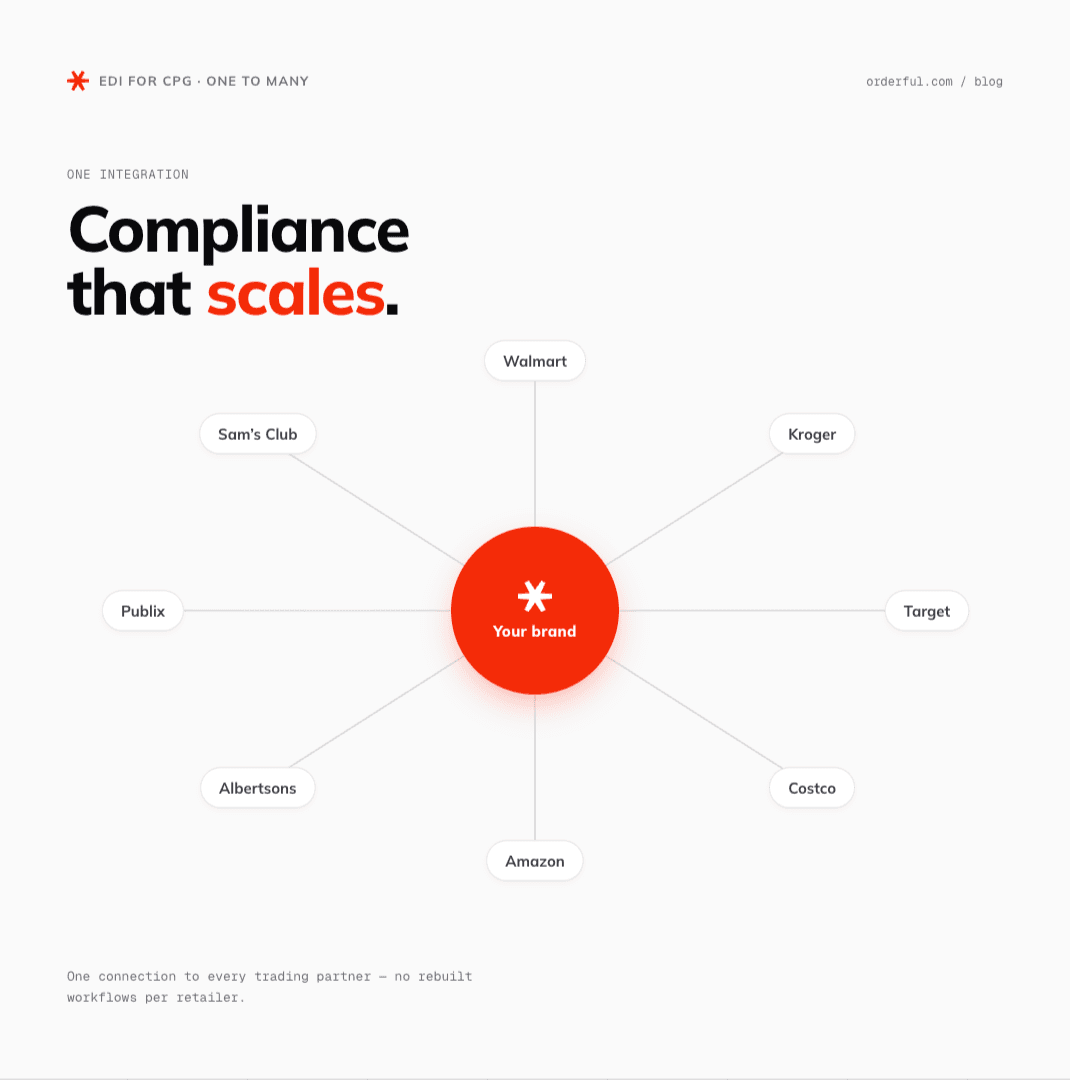
Learn what causes EDI compliance failures for CPG brands and how modern EDI systems reduce chargebacks, improve onboarding, and support scalable growth.
Consumer packaged goods (CPG) brands often don't realize they have a problem with their electronic data interchange (EDI) until the chargebacks start piling up. An electronic document that doesn't match retailer requirements can quickly turn into delayed payments, supplier scorecard penalties, and strained retail relationships. As brands expand, remaining EDI compliant becomes harder to manage consistently across trading partners.
Most operations and supply chain teams already know the basics of how EDI works. The main issue is maintaining accurate, compliant EDI transactions at scale while onboarding new retailers and keeping internal systems aligned. This article explores how modern EDI for CPG brands works in practice, what causes compliance breakdowns, and what it takes to support retailer requirements without slowing growth.
Why Retailer EDI Compliance Is a CPG Problem First
CPG brands operate in one of the most compliance-heavy retail environments in the supply chain. Large retailers like Walmart, Kroger, Target, and Costco, as well as big-box retailers, enforce strict EDI requirements because even minor document errors can disrupt inventory planning, warehouse operations, and replenishment timelines across thousands of stores. As transaction volume grows, maintaining retailer EDI compliance becomes more difficult, especially for brands managing multiple fulfillment partners, warehouses, and partner-specific workflows.
What Non-Compliance Actually Costs
For CPG brands, EDI compliance failures rarely stay isolated to a single transaction. A late advance ship notice (ASN), missing data element, or improperly formatted invoice can trigger retailer chargebacks, delayed payments, or temporary shipment holds. Over time, repeated errors can damage supplier scorecards and make it harder to maintain retailer relationships.
The Documents Retailers Actually Enforce
Retailers typically focus their compliance programs around a handful of critical EDI transactions.
EDI 850 purchase order: Contains the items and quantities that the buyer wishes to purchase
EDI 855 purchase order acknowledgment: Serves as confirmation from the supplier that they received the purchase order
EDI 856 ASN: Relays shipment details from a supplier to a buyer
EDI 810 invoice: Communicates the expected payment amount from the buyer
EDI 997 functional acknowledgment: Confirms the receipt of documents
Retailers expect these documents to follow strict formatting, timing, and routing requirements. Even minor inconsistencies in retailer requirements can lead to costly compliance failures.
What Does Retailer EDI Compliance at Scale Look Like?
Retailer EDI compliance becomes much harder as CPG brands add new sales channels and fulfillment partners. Processes that once worked for a handful of trading partners can break down as transaction volume increases and requirements become more complex. At scale, successful operations depend on core EDI capabilities like visibility, automation, and standardized workflows that reduce manual intervention before errors reach retailers.
Some of the most effective compliance-ready EDI operations share a few important characteristics:
Automated acknowledgments: Teams automatically process and return 997 functional acknowledgments so retailers can verify document receipt without delays.
Centralized transaction visibility: Supply chain and operations teams can monitor EDI transactions, exceptions, and retailer-specific issues from a single platform, rather than relying on disconnected systems or email chains.
ERP-connected workflows: EDI data flows directly into enterprise resource planning (ERP) applications and warehouse management systems (WMS) to reduce manual data entry and improve inventory and order accuracy.
Faster trading partner onboarding: Teams can onboard new retailers and fulfillment partners without rebuilding workflows or repeating extensive mapping processes for every connection.
Proactive validation and monitoring: EDI systems can test and validate business documents before submission, helping companies catch formatting or routing errors before they trigger retailer chargebacks.
Modern EDI operations help CPG brands maintain compliance consistently as retailer requirements shift and transaction complexity increases.
Where CPG Brands Break Down and Why
As retailer requirements become more complex, many CPG brands discover that their existing EDI processes weren't built to scale cleanly across many different trading partners. Teams often end up relying on disconnected systems, manual reviews, and retailer-specific workarounds that become harder to manage as transaction volume increases. Even companies with established EDI procedures can struggle to consistently meet retailer expectations when onboarding accelerates or internal systems fall out of sync.
Trading Partner Sprawl
Every retailer introduces different document specifications, testing requirements, routing rules, and fulfillment expectations. What works for one may not work for another, especially when brands expand. As the number of trading partners grows, onboarding timelines can slow down, and retailer-specific exceptions become harder to track reliably across teams.
Version and Spec Drift
Retailer EDI requirements don't remain static. Retailers may update document versions, change routing expectations, or enforce new standards over time. Without proper EDI mapping oversight and document validation, companies can continue sending outdated or incomplete data without realizing problems exist until chargebacks or rejected documents begin appearing.
Internal Handoff Failures Across Supply Chain Systems
Many compliance problems originate between internal systems rather than inside the EDI documents themselves. ERP systems, fulfillment providers, and customer systems may all store or process data differently. When teams rely on manual data entry, disconnected workflows, or delayed updates across systems, this can create data inconsistencies that quickly turn into compliance issues difficult to trace.
How to Build a Compliance-Ready EDI Setup
Building a compliance-ready EDI setup requires more than simply exchanging documents with retailers. CPG brands need workflows that can support increasing transaction volume, retailer-specific requirements, and faster onboarding timelines without creating more manual correction work for internal teams.
Some of the most effective EDI-compliant systems focus on a few core capabilities:
Standardized retailer workflows: Teams create repeatable processes for handling retailer-specific document requirements, routing rules, and fulfillment expectations instead of relying on one-off workarounds.
Automated functional acknowledgments: Automatically processing 997 acknowledgments helps retailers confirm document receipt quickly while reducing the risk of missed or delayed responses.
ERP and WMS integration: Connecting EDI directly to ERP applications and warehouse management systems reduces manual data entry and helps maintain consistent inventory, order, and fulfillment data across systems.
Exception monitoring and validation: EDI platforms that validate transactions before submission can help identify formatting issues, missing data, or EDI mapping problems before documents reach retailers.
Scalable trading partner onboarding: Faster onboarding processes help CPG brands expand into new retailers and fulfillment channels without repeatedly rebuilding the EDI mapping process or increasing operational overhead for every new connection.
Modern EDI providers also help companies adapt more quickly as retailer requirements evolve. Instead of reacting to compliance failures after chargebacks occur, teams can identify issues earlier and maintain more consistent operations across trading partners.
Scalable EDI Compliance Starts With the Right EDI Platform
As CPG brands expand into new retailers and fulfillment channels, maintaining retailer EDI compliance becomes increasingly difficult without scalable systems and standardized workflows. A modern API-driven EDI integration helps reduce manual processing, accelerate trading partner onboarding, and improve visibility across high-volume retail operations.
Orderful’s Mosaic platform helps companies connect EDI directly to ERP and supply chain systems through a modern API-first approach. This allows teams to onboard retailers faster, adapt to changing requirements more efficiently, and support long-term growth without adding unnecessary operational complexity. Suppliers looking for an EDI system that can support scalable retailer compliance can book a demo to see Orderful in action.
FAQs for Consumer Packaged Goods EDI
What Causes EDI Chargebacks for CPG Brands?
EDI chargebacks often happen when retailers receive incomplete, delayed, or improperly formatted documents. Common causes include inaccurate ASN data, missing purchase order details, delayed 997 acknowledgments, incorrect routing information, or invoice mismatches. Even small formatting errors can trigger retailer deductions when transaction volume is high.
Which EDI Documents Do Retailers Enforce Most Strictly?
Most retailer compliance programs focus heavily on the EDI 850 purchase order, 855 purchase order acknowledgment, 856 ASN, 810 invoice, and 997 functional acknowledgment. These documents support order processing, shipment visibility, invoicing, and document confirmation throughout the CPG supply chain.
How Long Does Trading Partner Onboarding Usually Take?
Trading partner onboarding timelines vary depending on retailer requirements, document complexity, testing procedures, and internal system readiness. Traditional onboarding processes can take weeks or months when companies rely heavily on manual mapping and retailer-specific workflows. Modern EDI platforms can often reduce onboarding time to a few days through reusable integrations and EDI automation.
What’s the Difference Between Retailer Compliance and EDI Compliance?
EDI compliance focuses on whether electronic business documents meet technical formatting and transmission standards required for all EDI users. Retailer compliance focuses on an individual retailer's standards, including labeling requirements, ASN timing expectations, routing instructions, packaging standards, and fulfillment performance metrics.
