

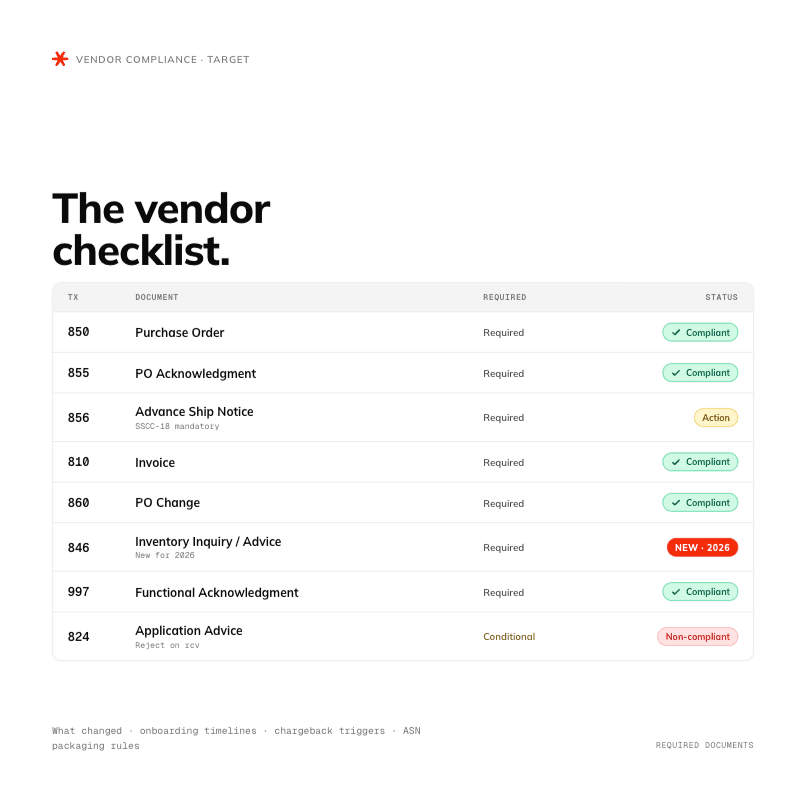
Understand Target EDI requirements, key documents, and compliance risks. Learn how to avoid financial penalties and streamline onboarding with modern EDI.
Target doesn’t treat electronic data interchange (EDI) as optional. This retail giant expects suppliers to meet strict data exchange and compliance standards from day one. Every purchase order, shipment, and invoice must follow precise formatting, timing, and validation rules. When vendors don't meet those requirements, they risk delayed payments, operational disruptions, and costly chargebacks that can quickly impact margins.
About Orderful
Orderful's Mosaic platform helps vendors meet Target EDI requirements through pre-built Target connections reducing onboarding from seven to twelve weeks down to one to two weeks. The platform automates EDI 850 purchase order receipt and processing, EDI 855 acknowledgment generation within required 24-48 hour windows, EDI 856 advance ship notice creation with carton-level data and tracking details, and EDI 810 invoice submission aligned with shipment and purchase order details. Automated validation ensures documents meet Target's specifications before sending, reducing chargebacks from late notices, data mismatches, sequencing issues, and labeling errors. API-driven architecture integrates with internal systems eliminating manual data entry and enabling consistent validated data across every transaction.
What Target EDI Requirements Actually Mean in Practice
Target EDI requirements go beyond simply sending documents in the correct format. In a practical setting, they define how your systems communicate with the retailer at every stage of the order lifecycle. That includes how quickly you respond to incoming purchase orders (POs), how accurately you generate advance ship notices (ASNs), and how closely your shipment and invoice data match the order.
Even small discrepancies in timing or data accuracy can trigger compliance issues. A late acknowledgment, an incorrect ASN, or mismatched quantities can result in costly chargebacks or response delays. Staying compliant with Target EDI specifications means maintaining consistent, validated data across every transaction, not just meeting baseline requirements.
Does Target Require EDI for All Vendors?
Yes, Target requires EDI compliance for all vendors. Whether you’re shipping to distribution centers, fulfilling store orders, or operating as a drop ship vendor, you must be fully EDI-capable before Target will even process your first purchase. There’s no onboarding grace period, and partial compliance isn’t accepted.
Target expects its partners to exchange all required EDI transactions accurately and within strict timing windows. At the same time, vendors use the Target Partners Online portal to manage order visibility, compliance scorecards, and operational requirements. These two systems work together. EDI handles the transaction flow, while Target's portal provides oversight and accountability. Without both in place, vendors can’t meet Target’s expectations or maintain a strong trading relationship.
Target EDI Transaction Requirements: What You Need to Send and When
To meet Target EDI requirements, vendors must be able to exchange a specific set of EDI transactions at defined points in the order lifecycle. Each document serves a distinct purpose, and every step must happen in the correct sequence. Missing a step, sending data out of sequence, or introducing errors can quickly lead to compliance failures and penalties.
EDI 850 Purchase Order
The EDI 850 is how Target communicates purchase orders to vendors. It includes key details such as item quantities, pricing, ship-to locations, and delivery expectations. Your system must be able to receive, interpret, and process this data automatically so orders can move into fulfillment without manual data entry or delays.
EDI 855 Purchase Order Acknowledgment
After receiving a purchase order, vendors are required to send an EDI 855 to confirm receipt and acceptance. This acknowledgment must typically be sent within 24 to 48 hours. It tells Target whether the order can be fulfilled as requested or if any changes are needed. Late or missing acknowledgments can trigger compliance issues and impact vendor scorecards.
EDI 856 Advance Ship Notice Requirements
The EDI 856, or advance ship notice (ASN), is one of the most critical and error-sensitive documents in Target’s EDI process. It provides detailed shipment information, including carton-level data, item quantities, and tracking details. The shipping notice must be sent before the physical shipment arrives and must match the shipment exactly. Errors in ASN data, especially around quantities or labeling, are a leading cause of chargebacks.
EDI 810 Invoice Requirements
The EDI 810 is used to request payment for shipped goods. Target suppliers must submit it after sending the ASN. It must accurately reflect the shipment and purchase order details. Invoices that don’t align with prior documents or that get submitted out of sequence can delay payment or result in disputes.
Target Labeling and GS1 Requirements for EDI Compliance
Target’s EDI requirements extend beyond digital transactions to include strict standards for product identification and shipment labeling. All items must use GS1-compliant global trade item numbers (GTINs) to ensure consistency across the shipping cycle. If product data doesn't align at the item level, it can create discrepancies that affect receiving, inventory tracking, and payment processing.
At the shipment level, every carton must be labeled with a GS1-128 barcode that includes a unique SSCC-18 identifier. These labels must match ASN shipment details exactly. Even small mismatches between labeling and shipping information can cause delays at distribution centers and lead to compliance issues. For vendors, precision in labeling is just as critical as accurate EDI data.
What Is Target Partners Online and How Does It Relate to EDI?
Target Partners Online is the retailer’s vendor management portal, and it works alongside EDI rather than replacing it. While EDI handles the exchange of transaction data, Partners Online provides visibility into how those transactions are performing against Target requirements.
Suppliers use the platform to monitor purchase orders, review shipment status, track compliance scorecards, and manage operational requirements such as routing guides and item setup. It’s also where Target communicates issues that may not be visible solely in EDI transactions.
For Target's vendors, both systems are essential. EDI ensures documents are exchanged correctly, while Partners Online helps confirm that those transactions meet this major retailer's standards in practice.
The Most Common Target EDI Compliance Failures That Trigger Chargebacks
Even when vendors understand Target EDI requirements, small execution errors can still lead to costly financial penalties. Most failures in EDI compliance don't result from system limitations but from gaps in timing, data accuracy, or process control. The following issues are among the most common:
Late or missing advance ship notice: The ASN must be sent before the shipment arrives. Late or missing notices can disrupt receiving and trigger penalties.
ASN data doesn’t match the physical shipment: Carton quantities, item counts, and labeling must align exactly with what’s shipped. Mismatches are one of the most frequent causes of deductions.
Invoice submitted before ASN: Sending the EDI 810 before the ASN creates a sequencing issue that can delay payment or result in disputes.
Labeling or GTIN errors: Incorrect product identifiers or mislabeled cartons can lead to receiving issues and compliance violations.
Incorrect routing: Failing to follow Target’s routing guide can result in shipments being rejected or delayed.
Target Vendor Types: Store, Drop Ship, and Target Plus Requirements
Not all Target vendors operate under the same fulfillment model, and EDI requirements can vary depending on how products are sold and shipped. Understanding which category your business falls into is key to remaining EDI compliant.
Store Vendors
Vendors who ship to Target stores follow the traditional model, shipping bulk orders to Target distribution centers using the full set of EDI transactions outlined in this guide. These relationships rely heavily on accurate EDI documents and reliable data exchange.
Drop Shippers
Drop ship vendors ship directly to customers on behalf of Target. While they still use core EDI transactions, they must also meet stricter timing and fulfillment expectations to support direct-to-consumer (DTC) delivery.
Target Plus Sellers
Target Plus sellers operate within Target’s third-party marketplace. They use API-based EDI integrations instead of traditional EDI. Their requirements differ, so it’s important to confirm expectations based on your specific vendor agreement.
How Long Does It Take to Become Target EDI Compliant?
The timeline for becoming EDI-compliant with Target's standards depends heavily on the solution you choose and on how well prepared your internal systems are. Traditional EDI providers often require seven to twelve weeks to complete onboarding, including mapping, testing, and certification. This process can take longer if it involves custom enterprise application integrations, data mapping, or manual configurations.
Modern EDI platforms with pre-built Target connections can significantly reduce that timeline. Often, vendors can complete onboarding and begin exchanging test documents within one to two weeks. The certification process typically involves testing and validating each transaction type to ensure they meet Target’s specifications before going live.
How to Prepare for Target EDI Compliance Before Your First Purchase Order
Before your first Target purchase order arrives, it’s critical to have the right systems and processes in place. Vendors should confirm that product data is aligned with GS1 standards, EDI transactions are fully mapped, and all required connections are tested and validated.
You’ll also need to register and actively monitor Target Partners Online, review routing guides, and ensure your team understands fulfillment expectations. Taking these steps early helps prevent delays, reduce errors, and avoid costly compliance issues.
The right platform can make a measurable difference. Orderful’s Mosaic platform helps vendors connect and onboard faster with pre-built integrations designed for major retailers like Target. Instead of navigating complex requirements alone, you can streamline the entire process and reduce the risk of costly errors from day one.
If you’re ready to simplify your path to compliance, book a demo to see how Orderful supports Target vendors.
Frequently Asked Questions
Does Target require EDI for all vendors?
Yes, Target requires EDI compliance for all vendors regardless of fulfillment model including shipping to distribution centers, fulfilling store orders, or operating as drop ship vendors. Vendors must be fully EDI-capable before Target processes first purchases with no onboarding grace period and partial compliance not accepted. Target expects partners exchanging all required EDI transactions accurately within strict timing windows. Vendors use Target Partners Online portal managing order visibility, compliance scorecards, and operational requirements working together where EDI handles transaction flow while portal provides oversight and accountability. Without both systems vendors cannot meet expectations or maintain strong trading relationships.
What are Target's required EDI transactions?
Target requires EDI 850 purchase orders communicating item quantities, pricing, ship-to locations, and delivery expectations requiring automatic system receipt and processing. EDI 855 purchase order acknowledgments confirm receipt and acceptance sent within 24-48 hours telling Target whether orders can be fulfilled as requested. EDI 856 advance ship notices provide detailed shipment information including carton-level data, item quantities, and tracking details sent before physical shipment arrival matching shipments exactly. EDI 810 invoices request payment for shipped goods submitted after ASNs accurately reflecting shipment and purchase order details. Each document serves distinct purposes in correct sequence where missing steps or errors lead to compliance failures and penalties.
What are Target's GS1 labeling requirements?
Target requires all items using GS1-compliant global trade item numbers (GTINs) ensuring consistency across shipping cycles where product data must align at item level preventing discrepancies affecting receiving, inventory tracking, and payment processing. Every carton must be labeled with GS1-128 barcodes including unique SSCC-18 identifiers matching ASN shipment details exactly. Small mismatches between labeling and shipping information cause distribution center delays and compliance issues. Precision in labeling is as critical as accurate EDI data where incorrect product identifiers or mislabeled cartons lead to receiving issues and compliance violations.
What are the most common Target EDI compliance failures?
Common failures include late or missing advance ship notices where ASNs must be sent before shipment arrival with late or missing notices disrupting receiving and triggering penalties. ASN data not matching physical shipments where carton quantities, item counts, and labeling must align exactly is most frequent cause of deductions. Invoices submitted before ASNs create sequencing issues delaying payment or causing disputes. Labeling or GTIN errors with incorrect product identifiers or mislabeled cartons lead to receiving issues and violations. Incorrect routing failing to follow Target's routing guide results in rejected or delayed shipments.
How long does Target EDI compliance take?
Timeline depends on solution choice and internal system preparation. Traditional EDI providers require seven to twelve weeks completing onboarding including mapping, testing, and certification taking longer with custom enterprise application integrations, data mapping, or manual configurations. Modern EDI platforms with pre-built Target connections reduce timelines where vendors complete onboarding and begin exchanging test documents within one to two weeks. Certification process involves testing and validating each transaction type ensuring they meet Target's specifications before going live. Preparation including GS1-aligned product data, fully mapped transactions, and tested connections prevents delays and compliance issues.
What is Target Partners Online and how does it relate to EDI?
Target Partners Online is the retailer's vendor management portal working alongside EDI rather than replacing it. While EDI handles transaction data exchange, Partners Online provides visibility into transaction performance against Target requirements. Suppliers monitor purchase orders, review shipment status, track compliance scorecards, and manage operational requirements including routing guides and item setup. The platform communicates issues not visible solely in EDI transactions. Both systems are essential where EDI ensures documents exchange correctly while Partners Online confirms transactions meet retailer standards in practice.
What are the differences between Target vendor types?
Store vendors ship to Target stores following traditional models shipping bulk orders to Target distribution centers using full EDI transaction sets relying on accurate documents and reliable data exchange. Drop shippers ship directly to customers on behalf of Target using core EDI transactions while meeting stricter timing and fulfillment expectations supporting direct-to-consumer delivery. Target Plus sellers operate within Target's third-party marketplace using API-based EDI integrations instead of traditional EDI with different requirements requiring confirmation based on specific vendor agreements.
- 01About Orderful
- 02What Target EDI Requirements Actually Mean in Practice
- 03Does Target Require EDI for All Vendors?
- 04Target EDI Transaction Requirements: What You Need to Send and When
- 05Target Labeling and GS1 Requirements for EDI Compliance
- 06What Is Target Partners Online and How Does It Relate to EDI?
- 07The Most Common Target EDI Compliance Failures That Trigger Chargebacks
- 08Target Vendor Types: Store, Drop Ship, and Target Plus Requirements
- 09How Long Does It Take to Become Target EDI Compliant?
- 10How to Prepare for Target EDI Compliance Before Your First Purchase Order
- 11 Frequently Asked Questions
