

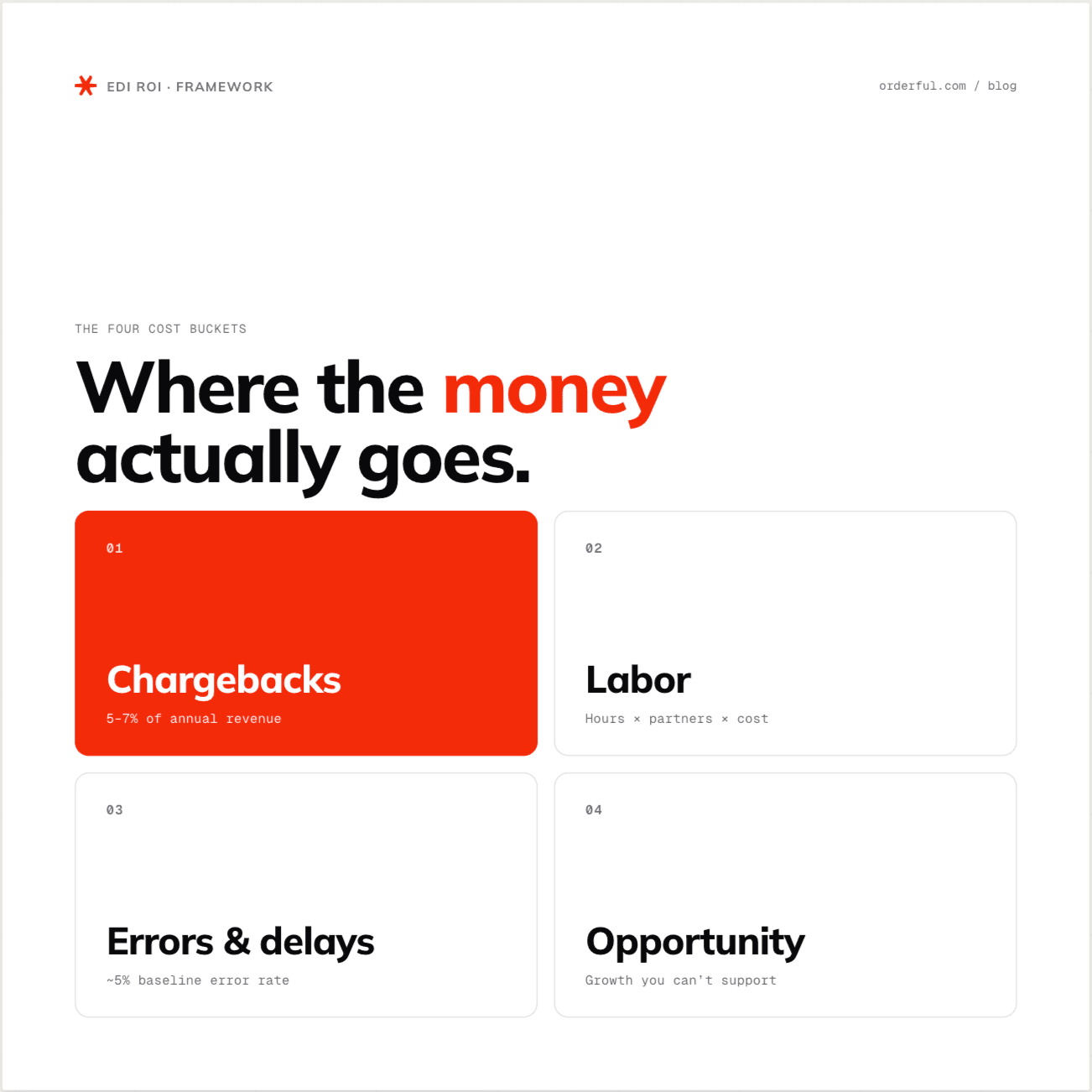
Manual EDI processes hide four measurable costs in chargebacks, labor, errors, and missed opportunities that compound over time, making ROI calculations essential for determining when to invest in modern EDI solutions.
For many organizations, the cost of switching to an electronic data interchange (EDI) solution feels immediate and easy to quantify. New software, implementation time, and internal changes all show up clearly in a budget. What’s harder to see is the cost of staying where you are.
Manual EDI processes don’t usually fail all at once. Instead, they create small inefficiencies across business documents, data entry, and partner communication that build over time. Missed orders, delayed shipments, and recurring errors quietly erode margins and slow growth.
That’s where most EDI ROI calculations fall short. They focus on visible costs while ignoring the ones that compound in the background. This article explores a practical framework to make those hidden costs measurable and actionable and shows how a modern EDI solution can help.
Why Brands Delay EDI Investment (And Misjudge EDI ROI)
For many teams, delaying the decision to invest in EDI is not because the need isn’t there. It’s often because the costs that justify the investment aren’t easy to identify.
Switching to a new EDI system entails visible costs, including implementation, integration with existing business systems, and the effort required to align internal processes. These are easy to point to and budget for.
The cost of staying with manual or paper-based processes works differently. It’s spread across teams, workflows, and trading partners. A few extra hours spent managing EDI transactions each week or a handful of errors in business documents don’t seem urgent on their own, but together they create a steady operational drag.
This is where many EDI business cases fall apart. “It’s working fine” becomes the default assumption, even when the underlying process is inefficient and fragile.
In reality, most companies don’t act until something forces the issue. A new retail partner with strict EDI requirements, the loss of a key team member, peak season failures, or a pattern of retailer chargebacks that can’t be ignored. It’s better to recognize these signals early and understand when to invest in a modern EDI integration before costs escalate.
The Four Cost Buckets Behind EDI ROI
Bucket 1: Chargeback Exposure
One immediate and measurable cost is chargeback exposure. Retailers enforce strict compliance requirements for EDI documents, including formatting, timing, and data accuracy. Even small errors in purchase orders, invoices, or shipping notices can trigger deductions.
For some brands, these deductions add up to a meaningful percentage of revenue. At the high end, companies can lose between 5% and 7% of annual revenue to chargebacks, compliance fines, and related penalties. Even a lower 1% to 2% rate can erode margin at scale.
This is a straightforward cost estimate. Multiply your average chargeback rate by your annual shipment value to get a baseline. From there, it becomes easier to see how improvements in data accuracy and compliance can translate directly into EDI cost savings.
Bucket 2: Labor Cost
Labor is one of the largest ROI components, especially for teams managing EDI manually. Each new trading partner introduces additional requirements, formats, and workflows, all of which require time to maintain.
When EDI processes rely heavily on manual data entry and exception handling, those hours add up quickly. A common way to estimate this cost is to calculate the number of hours spent managing EDI each week, multiply it by the number of trading partners, and then apply a fully loaded employee cost.
Research consistently shows that automation can reduce manual effort by 60% to 70% in EDI processes. That means a significant portion of this hidden labor cost is often avoidable.
There’s also a less visible risk. When EDI knowledge is concentrated with one or two employees, the business becomes vulnerable if those individuals leave.
Bucket 3: Error-Driven Delays and Missed Revenue
Manual entry increases the likelihood of errors in business documents and data exchange. While some mistakes can be caught and corrected quickly, others lead to downstream issues that impact fulfillment and revenue.
Incorrect or delayed EDI transactions can slow order processing, disrupt shipments, and reduce fill rates. Over time, this affects the retailer's view of a supplier’s reliability, which can impact long-term relationships.
Even in stable conditions, manual error rates can hover around 5%. During peak periods, when volume increases and teams are under pressure, error rates can spike significantly. These disruptions don’t just create extra work. They delay revenue recognition and extend the order-to-cash cycle.
Automated EDI systems help minimize these risks and control EDI costs effectively.
Bucket 4: Opportunity Cost
The most difficult cost to measure is often the most impactful. Opportunity cost represents the revenue and business growth that never materialize because existing systems can’t support it.
Manual EDI processes may work when you only have a few trading partner connections, but they rarely scale efficiently. As transaction volumes increase or new trading partners are added, the complexity grows faster than the team can keep up.
This limitation often shows up when a business tries to onboard a new retailer or expand into larger channels. Without the infrastructure to support standardized, high-volume data exchange, opportunities are delayed or lost entirely.
Adding headcount might seem like a solution, but it only increases cost without addressing the underlying inefficiency. Automated API-driven or cloud-based EDI systems provide the scalability needed to support growth without proportional increases in labor or risk.
A Simple EDI ROI Self-Scoring Framework
Understanding these cost buckets is only the first step. To build a clear EDI business case, you need a way to assess the impact each one has on your organization today.
A simple approach is to score your exposure across four areas: chargebacks, labor, errors, and opportunity cost.
Cost Bucket | Low Exposure | Medium Exposure | High Exposure |
|---|---|---|---|
Chargebacks | Rare or minimal deductions | Occasional compliance issues | Frequent chargebacks impacting revenue |
Labor | Limited manual effort | Moderate manual processes | Heavy reliance on manual EDI workflows |
Errors & Delays | Infrequent errors | Periodic disruptions | Frequent errors impacting fulfillment |
Opportunity Cost | No growth constraints | Some onboarding friction | Missed opportunities due to system limits |
Once you’ve scored each category, patterns start to emerge. High exposure across multiple areas is a clear signal that manual EDI processes are creating measurable financial and operational risk.
This makes it easier to quantify EDI ROI and determine when to invest in a more scalable EDI solution.
When Does EDI Software Pay for Itself?
At some point, the question shifts from whether EDI is worth the investment to how quickly it pays for itself. That answer comes down to comparing the cost of an EDI platform against the combined impact of chargebacks, labor, errors, and missed opportunities.
A simple break-even calculation starts with your current costs. Add up estimated losses from chargebacks, the time spent managing document exchange manually, and the revenue impact of delays or errors. Then compare that total to the cost of implementing EDI and maintaining it.
For many organizations, the results are clear. Companies moving from manual or legacy EDI systems to modern platforms often see significant cost reductions within the first year. In some cases, the payback period is measured in months.
Industry research supports this. Forrester Total Economic Impact studies have found that organizations that replaced manual EDI processes realized significant multi-year savings, with payback in under 3 months.
When these factors are combined, EDI return on investment becomes less of a projection and more of a measurable outcome.
The Hidden Cost of “It’s Working Fine” in Manual EDI
“It’s working fine” is one of the most common reasons companies delay EDI investment. It’s also one of the most expensive assumptions a business can make.
Manual EDI processes can appear stable when volumes are low and workflows are familiar. But that stability is fragile. A new trading partner with stricter requirements, a spike in order volume, or a change in internal resources can quickly expose the limits of manual systems.
What once felt manageable becomes a source of errors, missed expectations, and delayed payments. Teams spend more time correcting issues, retailers lose confidence, and operational efficiency continues to decrease. These problems don’t happen all at once. They build gradually until the process can’t keep up.
The cost of maintaining your traditional EDI practices comes down to how that inefficiency compounds over time. While the cost of switching to a modern, API-driven, or cloud-based EDI solution is a one-time EDI implementation cost, the cost of doing nothing continues to grow.
How Orderful Makes the ROI Case Easy to Build
Building a strong EDI business case is easier when the costs and outcomes are clear. Orderful’s API-driven EDI platform, Mosaic, simplifies implementation and reduces the operational burden of managing EDI at scale.
With predictable, per-trading partner pricing, you avoid the variable costs that make ROI difficult to measure. Faster onboarding timelines and automated workflows help reduce manual effort, improve data accuracy, and accelerate time to value.
Instead of estimating potential savings, you can measure them directly. When you’re ready to see how it works, book a demo and explore how Orderful supports measurable EDI cost savings.
Frequently Asked Questions
Why do companies delay EDI investment despite clear operational pain?
Companies delay EDI investment because visible switching costs including implementation, system integration, and internal process alignment are easy to budget for while costs of staying with manual processes spread across teams, workflows, and trading partners appearing manageable individually. A few extra hours managing transactions weekly or handful of errors in documents don't seem urgent independently but create steady operational drag compounded over time. Most companies don't act until external forces create urgency like new retail partners with strict EDI requirements, loss of key team members, peak season failures, or patterns of chargebacks becoming undeniable. Recognition of early signals helps organizations invest in modern EDI before costs escalate rather than waiting for crisis.
What are the four cost buckets in the EDI ROI framework?
The four cost buckets are chargeback exposure where retailers enforce strict compliance triggering deductions from formatting, timing, and data accuracy errors ranging from 1-2% to 5-7% of annual revenue at high end. Labor cost as major ROI component especially for manual EDI teams where each trading partner introduces additional requirements, formats, and workflows requiring time to maintain. Error-driven delays and missed revenue where manual entry increases errors in business documents disrupting order processing and fulfillment with error rates around 5% normally spiking significantly during peak periods. Opportunity cost representing revenue and growth never materializing because existing systems can't support expansion where manual processes don't scale efficiently as transaction volumes increase or new partners add complexity.
How do I calculate my labor costs for manual EDI?
Calculate labor by determining hours spent managing EDI each week including data entry, validation, exception handling, and troubleshooting. Multiply weekly hours by number of trading partners to get total manual effort per partner. Apply fully loaded employee cost including salary, benefits, taxes, and overhead to get total labor expense. Research shows automation reduces manual effort by 60-70% making significant labor cost portions avoidable through modern systems. Also consider less visible risk where EDI knowledge concentrated with one or two employees creates vulnerability if those individuals leave, representing hidden labor cost from business continuity risk.
How do I score my EDI cost exposure?
Score exposure across four areas using a simple framework assessing chargebacks as rare/occasional/frequent, labor as limited/moderate/heavy, errors as infrequent/periodic/frequent, and opportunity cost as no constraints/some friction/missed opportunities. For chargebacks multiply average rate by annual shipment value as baseline. For labor sum weekly hours across all manual EDI activities. For errors estimate revenue impact from delayed orders and fulfillment disruptions. For opportunity cost assess delayed partner onboarding or missed expansion due to system limitations. High exposure across multiple areas signals measurable financial and operational risk justifying modern EDI investment.
When does EDI software pay for itself?
Break-even calculation compares current manual costs against modern EDI platform cost. Add estimated losses from chargebacks, time spent managing document exchange manually with fully loaded labor costs, and revenue impact of delays or errors. Compare total to EDI implementation and annual maintenance costs. Most organizations moving from manual or legacy EDI to modern platforms see significant cost reductions within first year with payback periods often measured in months. Industry research including Forrester Total Economic Impact studies found organizations replacing manual EDI realized significant multi-year savings with payback under three months when chargebacks, labor, errors, and opportunity costs are measured together.
What's the hidden cost of assuming "it's working fine" with manual EDI?
Assuming manual EDI processes work fine is among most expensive assumptions businesses make. While stability appears present at low volumes and familiar workflows, that stability is fragile breaking under new trading partners with stricter requirements, order volume spikes, or internal resource changes. What feels manageable becomes error source, missed expectations, and delayed payments where teams spend increasing time correcting issues and retailers lose confidence in supplier reliability. These problems build gradually not happening at once until process can't keep pace. Manual process cost compounds continuously while modern EDI switching is one-time implementation cost making delay increasingly expensive over time.
How does Orderful simplify EDI ROI calculations?
Orderful's Mosaic platform simplifies business cases through predictable per-trading partner pricing eliminating variable costs obscuring ROI calculations. Faster onboarding compared to legacy systems reduces implementation burden, while automated workflows minimize manual effort improving data accuracy. Real-time compliance validation reduces chargebacks through error prevention before sending. Automation reduces manual effort by 60-70% directly lowering labor costs. Scalable infrastructure supports growth without proportional labor increases eliminating opportunity cost constraints. Transparent pricing and documented performance improvements allow organizations measuring results directly rather than estimating potential savings.
- 01Why Brands Delay EDI Investment (And Misjudge EDI ROI)
- 02The Four Cost Buckets Behind EDI ROI
- 03A Simple EDI ROI Self-Scoring Framework
- 04When Does EDI Software Pay for Itself?
- 05The Hidden Cost of “It’s Working Fine” in Manual EDI
- 06How Orderful Makes the ROI Case Easy to Build
- 07 Frequently Asked Questions
