

Growing retail brands outgrow SPS Commerce for three consistent reasons: unpredictable costs, slow trading partner onboarding, and a lack of direct visibility into EDI transactions.
In an electronic data interchange (EDI) environment, retailer chargebacks aren’t random occurrences. They’re the result of specific breakdowns in EDI transaction processes. When something goes wrong, retailer systems flag it automatically and apply financial penalties before teams even realize there’s an issue.
For many organizations, these deductions feel unpredictable because the root causes aren’t always readily apparent. This article breaks down the most common EDI compliance error chargebacks, what they cost, and how a modern EDI solution can help prevent them.
What Is an EDI Chargeback and How Does It Work?
Chargebacks are financial penalties that a retailer deducts directly from a supplier’s payment when specific compliance requirements are not met.
In most cases, retailers flag violations as they process transactions. That means retailer systems often apply chargebacks before sending a notification. Retailers also set strict dispute windows that can be easy to miss, because root causes aren't always immediately clear.
Error 1: Late or Missing ASN (EDI 856) — The Single Biggest Chargeback Trigger
The advance shipping notice (ASN) is one of the most critical documents in the retail EDI process. It tells the retailer exactly what’s arriving, how it’s packed, and when it's due.
Without an ASN, or if it arrives too late, warehouse teams lose visibility into incoming shipments, and receiving processes break down. Most major retailers require suppliers to transmit the ASN within a specific timeframe. When that window is missed, retailer systems trigger immediate chargebacks.
Error 2: ASN Sent After the Shipment Has Already Arrived
ASN timing matters. If suppliers transmit the document after the shipment has arrived, it doesn't meet retailer EDI compliance requirements because the data doesn’t support real-time receiving operations.
Warehouse management systems rely on ASN data to plan labor, allocate dock space, and process inbound goods efficiently. As a result, retailers issue chargebacks even if the ASN itself is technically accurate.
Error 3: ASN Quantity Doesn't Match the Physical Shipment
When the quantity listed in the advanced shipping notice doesn’t match what actually arrives, retailers can’t complete a clean three-way match between the purchase order, the ASN, and the physical shipment. Even small discrepancies create downstream issues that disrupt receiving and inventory accuracy.
When counts don’t align, warehouse teams have to stop, investigate, and manually reconcile the difference. This slows operations, creates inventory discrepancies, and often results in immediate chargebacks. Retailers like Costco may issue EDI chargebacks of up to $200 per incident or apply percentage-based deductions based on the total purchase order value.
Error 4: Wrong or Missing GS1-128 Label on Shipping Cartons
Retailers rely on GS1-128 shipping labels to identify, scan, and route cartons quickly through receiving and distribution. When labels are missing, incorrect, or unreadable, warehouse systems can’t match cartons to their corresponding ASN data, disrupting automated workflows.
Common causes of frequent chargebacks include incorrect SSCC-18 codes, barcodes that won’t scan, or labels that don’t align with the shipment data transmitted through EDI. These errors slow operations and increase labor costs. As a result, retailers impose chargebacks immediately. For example, Amazon may apply EDI chargebacks of $5 to $10 per carton, with higher penalties for ongoing compliance issues.
Error 5: GTIN or Item Number Mismatch Between the PO and Your Internal Records
When the GTIN or item number in your system doesn’t match what the purchase order shows, retailers can’t accurately process shipments. These data mismatches break the link between the order, the shipment, and the corresponding EDI documents, creating downstream issues.
This error often happens when companies introduce new SKUs, update packaging, or fail to synchronize internal systems with retailer requirements. Without consistent item data, retailers may reject shipments, delay processing, or issue direct financial penalties.
Error 6: Invoice (EDI 810) Submitted Before the ASN (EDI 856) — A Sequence Error Most Brands Don't Know They're Making
Retailers expect EDI documents to follow a specific sequence, and when that order breaks, it creates compliance issues. One of the most common mistakes is sending the invoice before the ASN, which disrupts how retailers validate and process shipments.
The ASN provides the receiving data that retailers use to confirm what was shipped. When suppliers send invoices first, retailer systems can’t complete validation, which causes the transaction to fail compliance checks. For example, Target requires suppliers to submit invoices only after the ASN is transmitted and within a defined timeframe.
Error 7: Duplicate Transaction IDs or Missing 997 Functional Acknowledgments
Every EDI transaction requires a unique identifier for accurate processing. When duplicate transaction IDs are sent, retailer systems may reject the document or create confusion in downstream processing, leading to delays and compliance issues.
The 997 functional acknowledgment confirms that a transaction was received and accepted. When suppliers fail to send or monitor these acknowledgments, they can't see whether retailers processed the documents successfully. Without that confirmation, errors can go unnoticed until they trigger chargebacks or direct penalties.
Error 8: Wrong Ship-To DC — Routing Guide Not Followed
Retailers require suppliers to follow detailed routing guides that specify exactly where shipments should be delivered. When a shipment is sent to the wrong distribution center, even if the EDI documents are correct, it creates significant operational disruptions.
Routing errors often happen when internal systems don't align with retailer requirements or when teams rely on outdated shipping instructions. These mistakes force retailers to reroute shipments, delay receiving, or manually correct the issue, all of which increase costs on their end. As a result, retailers issue costly chargebacks for failing to follow routing guidelines, regardless of whether the underlying EDI data was accurate.
What These Errors Cost: A Retailer Chargeback Reference
EDI compliance goes beyond simply sending documents correctly. It directly impacts how and when suppliers get paid and whether they remain in good standing with major retailers. When companies fall out of compliance, the financial consequences add up quickly.
Retailers like Walmart may apply penalties tied to OTIF performance, along with administrative fees for ASN or purchase order violations. Target often issues per-carton deductions for ASN errors, while Costco may apply flat fees or percentage-based penalties based on the total order value. Amazon Vendor Central can impose deductions ranging from 1% to 5% of invoice value, with higher penalties during peak periods.
Maintaining EDI compliance isn’t just about avoiding immediate financial deductions. Frequent violations can lead to ongoing financial penalties, strained relationships with trading partners, and lower supplier performance scores.
How to Move From Reacting to Chargebacks to Preventing Them
Retail chargebacks are often treated as an unavoidable cost of doing business, but they’re usually the result of preventable process failures. To prevent chargebacks, companies need better visibility into their EDI transactions and stronger control over how documents are created, validated, and transmitted.
Modern EDI systems make it easier to achieve compliance by reducing manual intervention and automatically enforcing retailer-specific requirements. Instead of reacting to errors after they happen, teams can identify issues earlier in the process and resolve them before they impact shipments or payments.
Pre-Transmission Validation
Pre-transmission testing and validation ensure that EDI documents meet retailer requirements before they are sent. By reviewing data early, companies can catch issues such as missing fields or mismatched values before they trigger compliance errors.
Without this step, errors often go unnoticed, which increases the likelihood of chargebacks. With proper validation and testing procedures in place, teams can maintain compliance and reduce the risk of costly downstream corrections.
Real-Time Error Visibility
Immediate visibility into errors gives teams insight into failed or delayed EDI transactions. Instead of discovering issues after they’ve already triggered penalties, teams can identify and resolve problems as they happen.
A clear view into errors helps companies stay ahead of compliance issues and maintain consistent data accuracy across trading partners. With better monitoring in place, teams can respond faster, reduce disruptions, and avoid preventable chargebacks.
Automated Compliance With Retailer Requirements
Automating compliance with retailer-specific EDI requirements is one of the most effective ways to reduce chargebacks. Many common errors stem from manual data entry and human error, especially when teams rely on disconnected systems or outdated processes.
A modern EDI platform helps prevent EDI chargebacks by standardizing document creation, validation, and transmission. By automatically enforcing retailer requirements, teams can eliminate chargebacks caused by avoidable mistakes and maintain consistent compliance. This approach not only reduces financial penalties imposed by retailers but also improves overall operational efficiency.
How to Prevent EDI Chargebacks and Maintain Compliance at Scale
EDI chargebacks aren’t unavoidable. They’re the result of gaps in visibility, validation, and process control. When companies take a proactive approach to maintaining EDI compliance, they can reduce errors, improve data accuracy, and avoid surprise financial penalties.
A modern EDI platform gives teams the tools to manage transactions with greater confidence, from validation and monitoring to automated compliance with retailer requirements. Instead of reacting to issues after they happen, teams can prevent them entirely.
If you’re ready to reduce chargebacks and take control of your EDI operations, book a demo to see how Orderful helps teams prevent errors and maintain compliance at scale.
Frequently Asked Questions
What Is an EDI Chargeback?
An EDI chargeback is a financial penalty that a retailer deducts directly from a supplier's payment when specific EDI compliance requirements are not met. Retailers flag violations automatically as transactions are processed, which means chargebacks are often applied before suppliers receive any notification.
What Are the Most Common EDI Errors That Cause Chargebacks?
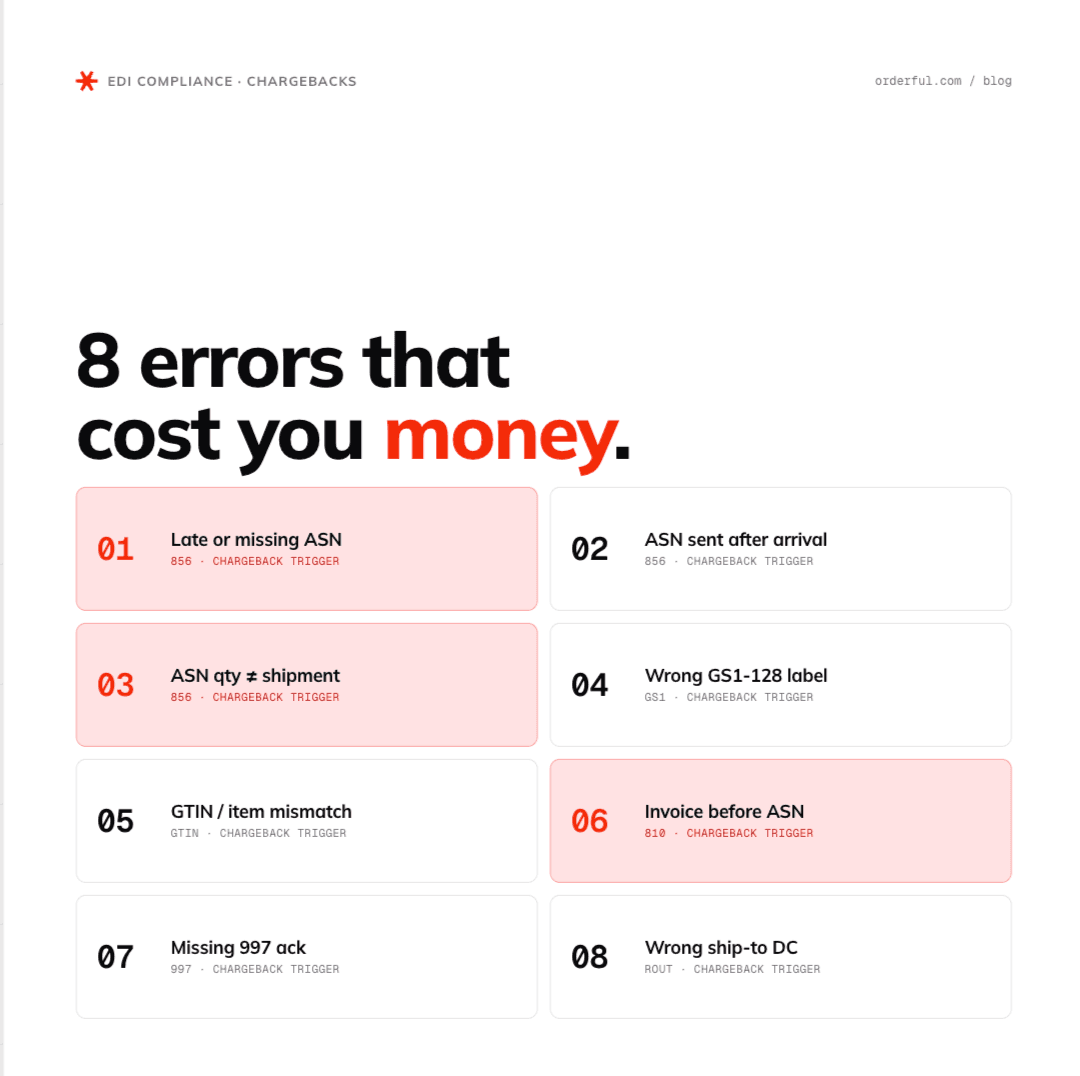
The most common EDI errors that trigger chargebacks include late or missing ASNs (EDI 856), ASN quantity mismatches, incorrect GS1-128 labels, GTIN or item number discrepancies, invoices submitted before the ASN, duplicate transaction IDs, missing 997 acknowledgments, and shipments sent to the wrong distribution center.
How Much Do EDI Chargebacks Cost?
EDI chargeback costs vary by retailer and violation type. Amazon may deduct 1% to 5% of invoice value, with higher penalties during peak periods. Costco may apply flat fees up to $200 per incident or percentage-based deductions. Amazon Vendor Central can charge $5 to $10 per carton for label errors, with escalating penalties for repeat violations.
How Do You Prevent EDI Chargebacks?
Preventing EDI chargebacks requires pre-transmission validation to catch errors before documents are sent, real-time visibility into transaction status, and automated enforcement of retailer-specific requirements. Modern EDI platforms like Orderful standardize document creation and validation to eliminate the manual errors that cause most chargebacks.
Why Does Sending an Invoice Before an ASN Cause a Chargeback?
Retailers require EDI documents to follow a specific sequence. The ASN provides receiving data that retailers use to validate what was shipped. When an invoice arrives first, retailer systems cannot complete that validation, causing the transaction to fail compliance checks and triggering a chargeback even if the invoice itself is accurate.
What Is a 997 Functional Acknowledgment in EDI?
A 997 functional acknowledgment is an EDI document that confirms a transaction was received and accepted by the trading partner. When suppliers fail to monitor 997s, they lose visibility into whether retailers successfully processed their documents, allowing errors to go undetected until they result in chargebacks or payment delays.
