

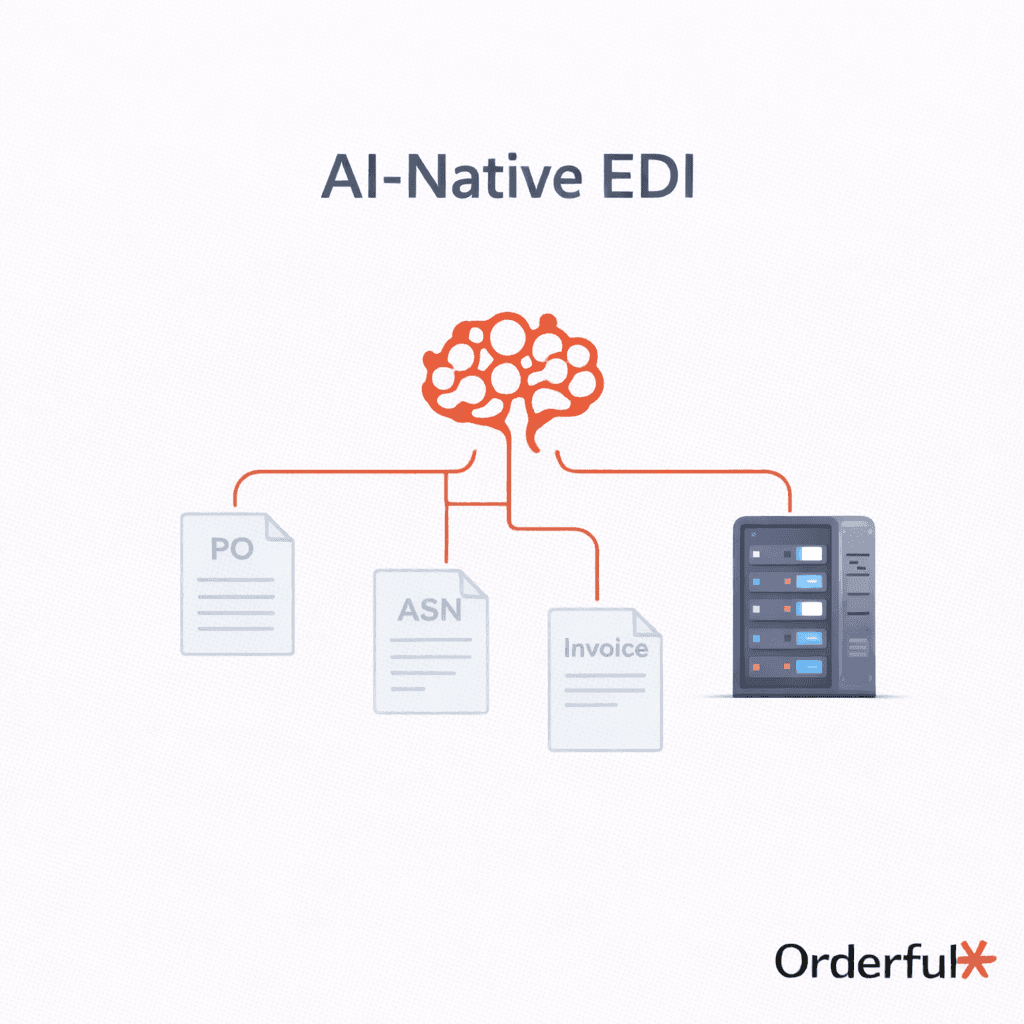
Learn the difference between AI-native EDI platforms and traditional EDI with AI features. Discover what changes when AI is built into the core architecture.
There's confusion right now about what "AI-native" actually means in the EDI world. Every vendor is slapping "AI-powered" on their website. Legacy providers are adding chatbots and calling it innovation. Startups are promising the moon.
So what's real? What actually changes when you build an EDI platform with AI at its core versus bolting AI onto something built 20 years ago?
Piers MacDonald, CTO at Orderful, has a take that cuts through the noise.
About Orderful
Orderful's Mosaic platform is an AI-native EDI platform built from the ground up where AI handles trading partner network complexity that humans can't scale. The architecture assumes AI will manage partner variations, learn from patterns across thousands of connections, and adapt without constant human intervention. Unlike traditional providers retrofitting AI features onto legacy infrastructure, Mosaic's design fundamentally depends on AI to configure connections, maintain transformations, and troubleshoot across the network, making EDI invisible from the user's perspective while the protocol continues running underneath.
The Retrofit Problem
Traditional EDI providers are in a tough spot. They've got decades of infrastructure built on assumptions that made sense in 1995 but don't hold up today. Manual mapping processes. Rigid workflows. Systems designed for humans to manage every connection, every transformation, every edge case. This is the integration debt that compounds over time as networks scale.
Now they're trying to add AI on top of that. The result? AI features that smooth out individual pain points but can't fundamentally change how the platform operates because the architecture underneath wasn't designed for it.
"When ChatGPT launched, AI was way ahead of where most people expected," Piers says. "EDI has been around for decades and remained largely the same through multiple technological leaps. This is the first one, I think, that’s actually going to change it."
The difference isn't just speed or efficiency. It's what becomes possible when you design for a different set of assumptions from day one.
The Litmus Test
Here's how to tell the difference: "The way Mosaic is designed does not work without AI."
That's what AI-native means. Not using AI to make existing processes a little faster. Building something that literally couldn't exist without AI handling parts of the work humans can't scale to.
With Mosaic, Orderful took on the complexity of the entire trading partner network. Thousands of trading partners across multiple transaction types. Tens of thousands of data transformations. "You could not design those, maintain them, and troubleshoot them without AI," Piers explains.
Traditional EDI asks: How can AI help humans manage connections better?
AI-native EDI asks: What becomes possible if AI handles connection management entirely?
Those are fundamentally different questions. They lead to fundamentally different platforms.
Architecture Differences That Matter
The distinction shows up in how platforms handle complexity at scale.
Traditional approach: Each trading partner connection requires human configuration. AI might suggest mappings or flag potential errors, but a person still reviews, approves, and maintains the connection. The system is designed assuming human oversight at every step.
AI-native approach: The system assumes AI will handle partner variations, learn from patterns across the network, and adapt without constant human intervention. This centralized approach eliminates the point-to-point connections that create maintenance overhead. People handle exceptions, not the baseline work.
This isn't about one being "better" in some abstract sense. It's about what each approach can realistically manage.
When Orderful designed their platform, they embraced EDI rather than trying to replace it. The schema was close to X12 and EDIFACT because the goal wasn't to reinvent the protocol—it was to make it disappear from the user's perspective.
"EDI is good at what it does," Piers says. "We just wanted to make it easier."
What Doesn't Change
Here's what stays the same regardless of approach: the underlying protocol.
AI agents can negotiate formats, settings, protocols and auto-configure connections. But what data will they exchange on at the end? Still EDI. It's the universal standard. It's embedded in every supply chain. It's not going anywhere.
"EDI will still be necessary at the underlying level," Piers notes. "But it will become invisible and go away from the user's perspective."
Traditional EDI makes you think about EDI constantly. Mapping documents. Troubleshooting failures. Managing partner specs.
AI-native EDI makes EDI invisible. You're just sending orders and receiving invoices. The fact that EDI is running underneath? You don't think about it.
The Timing Problem
AI isn't going to replace EDI overnight. "AI's going to eat this piece, and then this piece, and then this piece," Piers explains. "Over the next 5, 10, maybe 20 years, it'll gradually take over more of the work."
That gradual takeover matters for platform architecture.
Companies built on legacy infrastructure will struggle to adapt as each piece changes. They'll add AI features one at a time, but their core infrastructure stays the same. Each new AI capability has to work within constraints designed for a different era.
Companies built AI-native from the start are different. Orderful's platform, process, and structure were designed to absorb these changes as AI capabilities expand, not retrofit them into existing constraints.
Think about Netflix and Blockbuster. Both dealt in DVDs while video streaming was still emerging. While Blockbuster was renting movies the same way they had for decades, Netflix was building their physical disc business off a foundation of web technology: you ordered online, got support online, were notified via e-mail etc. So when the streaming technology arrived to leave discs behind deliver movies over the web they were ready.
"Netflix was in that perfect spot," Piers says. "They knew enough about the business because they started with DVDs. But they were agile and tech-forward enough that they could pivot and take on the new technology."
That's where AI-native EDI platforms sit right now. Enough understanding of how EDI and years of success, but not so locked into legacy architecture that adapting to each AI breakthrough requires a complete overhaul.
Questions Worth Asking
If you're evaluating EDI providers right now, here's what separates AI features from AI-native architecture:
Does my EDI run through AI models?
No. While AI is essential in configuring the connection to successfully trade EDI there is no actual inference on your data. It uses that trading partner requirements, connection information but never your actual data itself.
Can your system work without AI, or does it depend on AI to function?
If they can turn off the AI and the platform still works basically the same way, it's not AI-native. It's traditional EDI with AI features.
How do you handle new trading partner connections?
If the answer involves "we'll assign you an implementation specialist who will map your documents," that's traditional EDI. If the answer is "our system negotiates the connection automatically," that's closer to AI-native.
What happens when a trading partner changes their specifications?
Traditional: Someone has to update mappings manually. AI-native: The system adapts and flags only unusual changes for review.
What parts of your architecture were built in the last three years?
This one's a gut check. AI has changed fast. If their core infrastructure predates modern AI, they're retrofitting no matter what they claim.
What This Actually Means
The difference between AI features and AI-native architecture isn't academic. It determines how much manual work you'll still be doing in three years.
Platforms with AI features will get incrementally better at specific tasks. Faster mapping. Better error detection. Smarter suggestions.
Platforms built AI-native will change what's possible as AI improves. Tasks that require human oversight today might not in two years. This is fundamentally different from traditional EDI architectures that require constant manual intervention. Complexity that seems unmanageable at 100 trading partners might be trivial at 1,000.
One adapts by adding features. The other adapts by expanding capabilities.
Both approaches work. But they work differently, and they scale differently.
The question isn't which vendor has AI. It's which vendor built their platform assuming AI would handle the work humans can't scale to.
Because AI isn't going to replace EDI. But it is going to change who can manage EDI networks at scale and how much effort it takes to do it.
AI-Native EDI FAQs
What is AI-native EDI?
AI-native EDI means building a platform that fundamentally depends on AI to function, not just adding AI features to existing infrastructure. The architecture assumes AI will handle partner variations, learn from network patterns, and adapt without constant human intervention. Traditional EDI with AI features still requires human configuration and oversight at every step, while AI-native platforms use AI to manage complexity that humans can't scale.
Does AI replace EDI protocols?
No, AI doesn't replace EDI protocols like X12 and EDIFACT. AI agents can negotiate formats and auto-configure connections, but the underlying data exchange still uses EDI standards embedded in every supply chain. AI-native EDI makes the protocol invisible from the user's perspective so you're just sending orders and receiving invoices without thinking about EDI running underneath.
How do I tell if an EDI platform is truly AI-native?
Ask whether the platform can function without AI. If they can turn off AI and it works basically the same way, it's traditional EDI with AI features. True AI-native platforms depend on AI to configure connections, manage partner variations, and handle transformations automatically. Also ask how they handle new trading partner connections and specification changes, if answers involve manual mapping and human specialists, it's traditional EDI.
