

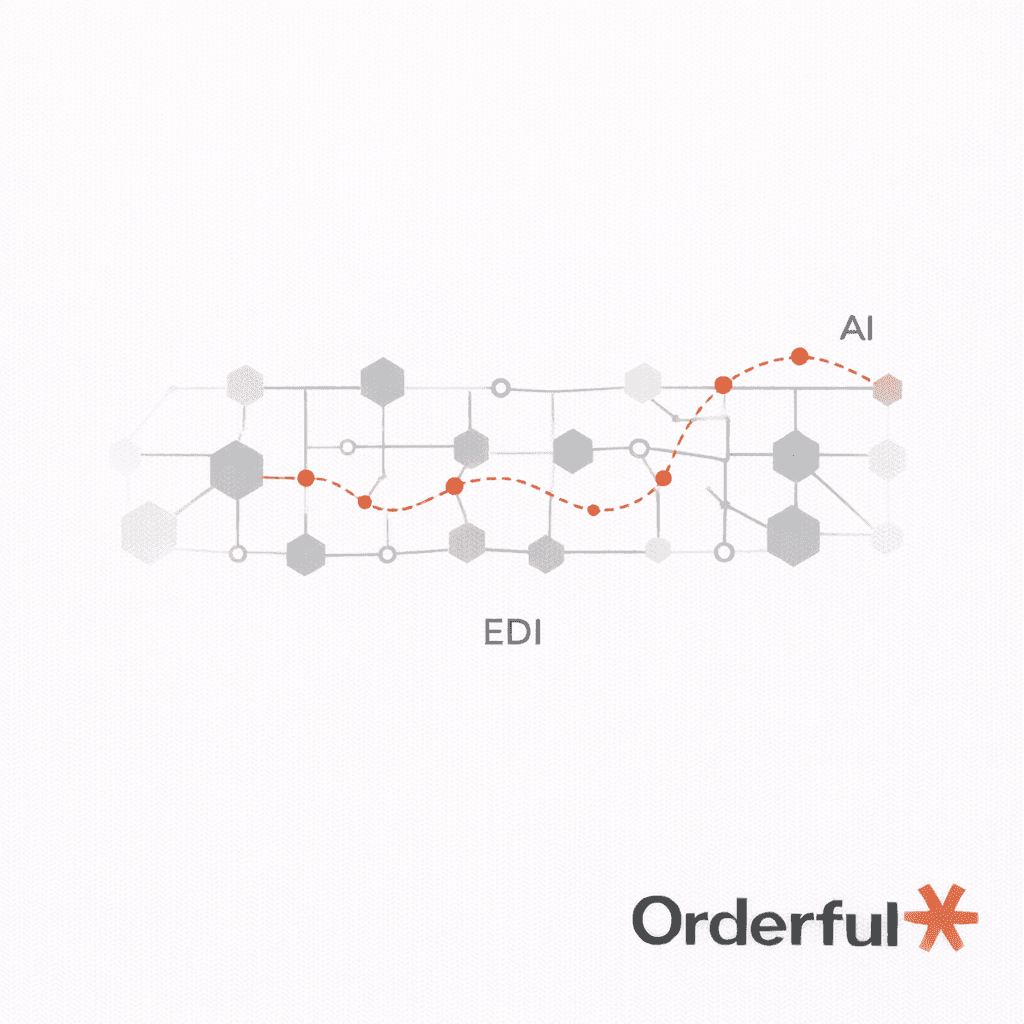
Learn how AI is changing EDI operations by reducing manual effort in mapping, maintenance, and troubleshooting while EDI remains essential for data exchange.
Every few years, EDI becomes the target of a familiar argument.
It is labeled outdated. Too rigid. Too closely tied to older systems. The latest version of that argument claims AI will finally clear it out of the way.
That framing comes up often, but it skips over something important. When Orderful’s CTO, Piers MacDonald, talks about EDI, he avoids the usual metaphors.
“People like to call EDI a dinosaur,” he said. “I don’t like that analogy. Dinosaurs are dead. EDI is more like a shark.”
The comparison is intentional. Sharks have stayed around because they work well in difficult environments. EDI has followed a similar path. It has survived decades of changing software stacks, shifting standards, and growing global trade because companies still need a dependable way to exchange data across systems that were never designed to match.
AI changes how that exchange is handled, but not why it exists.
How AI Affects EDI
AI is changing how EDI work is handled, not what EDI is used for. EDI remains the standard way businesses exchange structured data across systems. AI reduces the manual effort required to map, maintain, and troubleshoot those exchanges at scale.
This distinction matters. It separates real progress from inflated expectations.
Why EDI Has Lasted This Long
Global trade runs on mismatched systems. Retailers, manufacturers, distributors, and logistics providers all operate different software, built at different times, with different assumptions baked in. Those systems still need to exchange orders, invoices, shipping details, and inventory updates with consistency.
EDI sits between those systems. It does not remove differences, but it creates enough structure for trade to function across them.
That role has remained steady even as surrounding technology has shifted. Interfaces changed. Infrastructure evolved. Standards expanded. The need for a shared exchange layer remained.
EDI lasted because it addressed a coordination problem that never fully disappeared.
What Actually Creates the Work in EDI
Most EDI work comes from variation.
Trading partners interpret requirements differently. Retailers introduce exceptions. Edge cases appear long after a connection appears stable. Over time, those differences accumulate into ongoing effort.
Historically, that effort relied on hand-written rules and frequent maintenance. The approach worked, but it placed a heavy burden on teams as networks grew larger and more interconnected.
This is where AI becomes relevant in practical ways.
How AI Is Being Used Today
AI performs well when dealing with translation, pattern recognition, and prediction. Those strengths align closely with the realities of EDI networks.
Instead of treating every new trading partner or requirement change as isolated, AI can learn from patterns already present across the network. Similar partners tend to behave in similar ways. Many issues repeat with small variations.
At scale, this reduces the amount of human intervention required to keep exchanges stable.
This thinking influenced the design of Mosaic, Orderful’s AI-native EDI platform. Mosaic was built around the idea that large EDI networks require systems that learn from existing trading relationships, rather than relying only on static rules that must be updated by hand.
Does AI Replace EDI?
AI does not replace EDI. It reduces the operational effort around it.
EDI continues to act as the shared exchange layer once systems agree on how data should move between them. AI helps reach that agreement faster and maintain it with less manual work.
“I think EDI becomes hidden,” MacDonald said. “But it doesn’t go away.”
That pattern mirrors other infrastructure shifts. The mechanism stays in place. The friction around it gradually fades from view.
What Comes Next
As automation expands, more early-stage work between companies may be handled by software. Systems may compare requirements, evaluate options, and negotiate certain terms automatically.
Even then, shared protocols remain necessary.
“Two AI agents will negotiate,” MacDonald said. “What they’ll agree on is how to trade EDI.”
Once decisions are made, data still needs a predictable path between systems. EDI already provides that path across industries and regions. The exchange layer remains. The work around it continues to shrink.
What This Means in Practice
AI is changing how EDI work is managed behind the scenes. Partner setup requires less manual effort. Ongoing maintenance demands less attention. Issues surface earlier and resolve faster.
For most businesses, the change will feel quiet. Fewer interruptions. Fewer long debugging sessions. Less time spent thinking about how data moves between systems.
EDI remains in place, doing what it has always done. It simply asks for less.
Ready to reduce the manual work around your EDI operations? Book a demo to see how Orderful's AI-native platform learns from your trading partner network, or speak with an EDI expert about your current challenges.
