

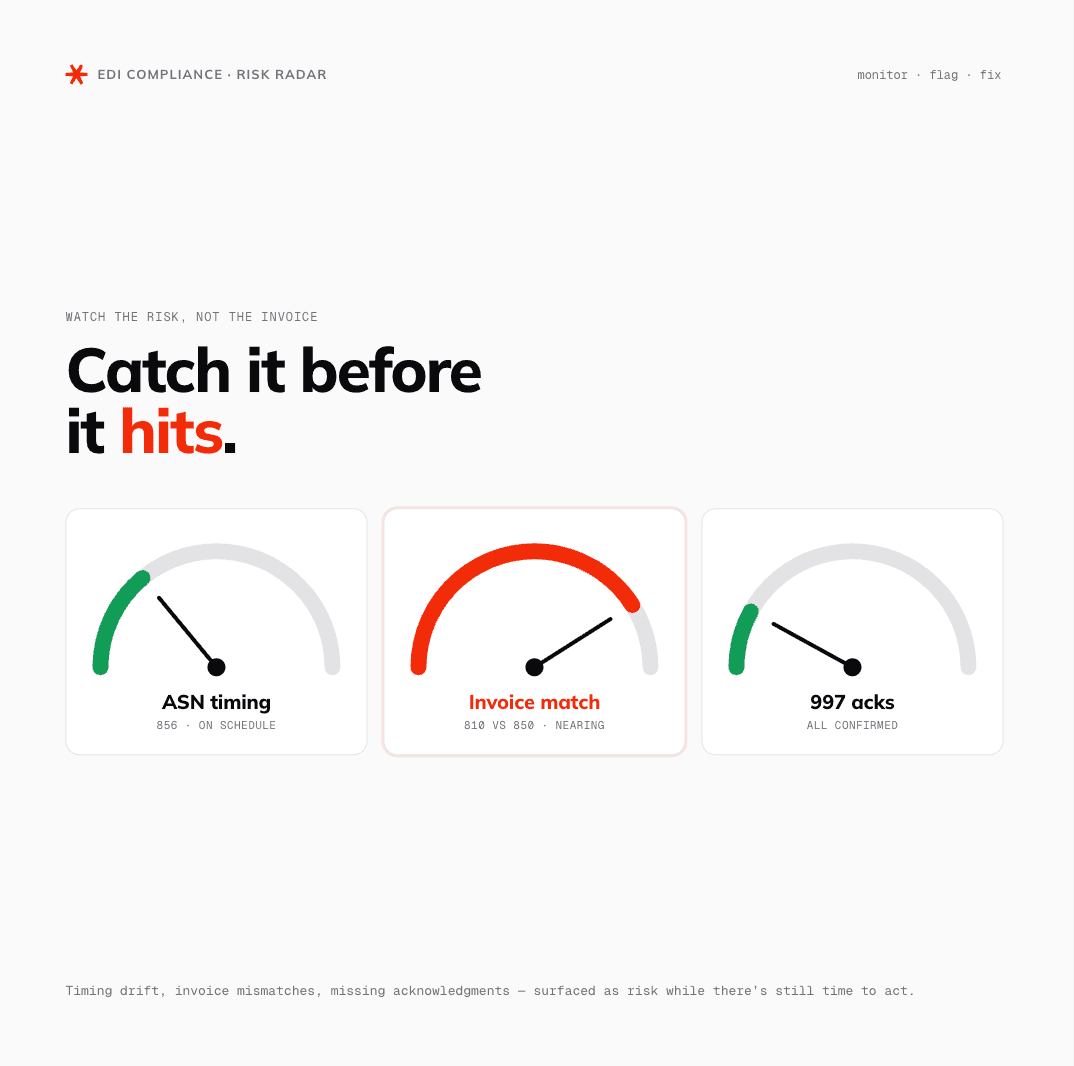
Compliance fees usually come from small, unnoticed EDI failures, not missing EDI. Late ASNs, invoice mismatches, and missing 997s are the top causes. Monitoring these signals early helps teams catch issues before deductions hit.
Organizations don't have to accept retailer compliance deductions as just another part of doing business. These financial penalties rarely happen because a company doesn't have electronic data interchange (EDI) in place. More often, they happen because teams don't realize something in their transaction flow has quietly broken until a chargeback notice arrives weeks later.
Late document submissions or mismatched data can trigger unexpected fees even when document exchange is going as planned. Ongoing compliance visibility across trading partners matters just as much as connectivity itself.
Understanding how to reduce EDI chargebacks starts with identifying failures before they turn into costly deductions. This article explores the signals retailers monitor and how a modern EDI solution can proactively identify compliance risks to help companies catch issues early.
Why Compliance Fees Keep Happening Even When You Have EDI
Many companies assume that once EDI is up and running, compliance issues should largely disappear. In reality, retailer compliance programs are built around ongoing transaction accuracy, timing, and validation. A company may successfully exchange documents with a retailer every day while still accumulating fees tied to missing data, formatting errors, or missed delivery requirements.
Major retailers use automated compliance systems to evaluate incoming EDI transactions against retailer-specific requirements and routing guides. If an ASN arrives late, invoice data doesn't match the original purchase order, or a shipment contains incorrect labeling information, the retailer's system may automatically generate financial penalties before anyone manually reviews the order.
That's why EDI compliance deductions often feel unpredictable to suppliers. The issue boils down to whether or not the data met the retailer's operational requirements at every stage of the transaction lifecycle. Without visibility into transaction status and validation failures across trading partners, companies may not recognize recurring compliance issues until retail vendor chargebacks begin affecting supplier payments and operational performance.
Which EDI Failures Generate the Most Deductions?
Most retailer compliance fees stem from small transaction-level issues that quietly disrupt order fulfillment, shipment validation, or supplier payment workflows. Automated compliance systems flag these problems quickly, often before suppliers realize anything went wrong.
While retailer-specific requirements vary, a handful of common EDI failures consistently trigger chargebacks across major retailers. Understanding where these failures occur makes it easier to identify root causes early and prevent chargebacks before deductions begin accumulating.
Late or Missing ASNs (EDI 856)
Late or inaccurate advance shipping notices are a common cause of retailer compliance deductions. Many retailers rely on ASN data to prepare distribution centers for incoming shipments, validate contents, and coordinate receiving before a shipment arrives.
Incorrect data or quantity mismatches can create receiving discrepancies. Many retailers also enforce strict ASN timing requirements, sometimes requiring suppliers to submit EDI 856 documents before a truck reaches the distribution center.
Because ASN compliance directly affects inventory management and order fulfillment visibility, retailers often treat these violations aggressively. Monitoring ASN timing, shipment validation data, and retailer-specific routing confirmation requirements can help companies identify compliance risks before retailer fees begin accumulating.
Invoice and PO Mismatches (EDI 810 vs. 850)
Retailers depend on accurate invoice and purchase order data to automate supplier payments and verify incoming orders. When invoice details don't match the original EDI 850 data, retailers may pause payment processing or automatically apply deductions.
These mismatches often involve pricing discrepancies, quantity errors, invalid item numbers, or formatting inconsistencies between EDI transactions. Even small errors can break the matching process retailers use to compare purchase orders, invoices, and shipment data before approving payment.
Because many retailers process large transaction volumes with minimal human intervention, invoice discrepancies can quickly trigger chargebacks. Monitoring invoice validation errors, PO number accuracy, and recurring mismatches across trading partners can help companies identify root causes early and prevent retail chargebacks.
Functional Acknowledgment Failures (EDI 997)
Functional acknowledgments help confirm whether a retailer's EDI system successfully received and processed EDI transactions. When an EDI 997 acknowledgment fails or never arrives, suppliers may not realize a transaction was rejected, delayed, or never confirmed by the retailer's system.
These failures can happen because of mapping issues, formatting problems, transmission interruptions, or retailer validation errors. Retailers may treat unacknowledged transactions as missing entirely, which can create compliance issues tied to shipment timing, invoices, or order processing.
Because 997 failures aren't always immediately visible, they can quietly create recurring compliance problems across trading partners. Monitoring acknowledgment status and unresolved transaction errors helps companies identify failed documents earlier and reduce chargebacks tied to missing or rejected EDI transactions.
How to Read Your EDI Data as a Compliance Signal
Retailer deductions for non-compliance rarely appear without warning. In many cases, EDI transaction data already contains signals that something in the fulfillment or validation process is beginning to break down. The challenge is recognizing those patterns early enough to correct issues before deductions accumulate.
Teams can often identify compliance risks by monitoring transaction timing, acknowledgment activity, recurring validation failures, and retailer-specific rejection trends across trading partners. A sudden increase in ASN timing discrepancies, unresolved 997 acknowledgments, or invoice validation errors may indicate larger operational issues that could eventually trigger retailer chargebacks.
EDI Failure Type | Common Retailer Consequence | Signal to Monitor |
|---|---|---|
Late or missing ASN | Shipment compliance deductions | ASN submission timing |
Invoice mismatch | Delayed supplier payments or chargebacks | Recurring PO or quantity discrepancies |
Missing 997 acknowledgment | Rejected or unprocessed transactions | Unconfirmed document status |
Incorrect shipment data | Receiving or inventory discrepancies | Validation and labeling errors |
Monitoring these patterns helps companies move beyond reactive to proactive compliance management. Instead of waiting for retailer deductions to appear after the fact, teams can use EDI data to identify root causes earlier, consistently meet compliance requirements, and reduce the operational costs associated with recurring transaction failures.
What a Proactive Compliance Process Looks Like
Reducing retailer compliance fees requires more than correcting problems after a chargeback appears. Companies with strong ongoing compliance processes actively monitor EDI activity for early warning signs, validate transaction accuracy before documents reach retailers, and track recurring issues across trading partners. Proactive measures help teams identify operational problems sooner, reduce manual intervention, and prevent small transaction failures from turning into larger compliance issues.
Key elements of a strong compliance process include:
Monitoring acknowledgments daily: Reviewing 997 acknowledgment activity helps teams identify rejected, delayed, or unconfirmed transactions before they affect shipments or supplier payments.
Validating ASN timing before shipment arrival: Monitoring the timing of EDI 856 ASN submissions helps reduce compliance risks associated with receiving delays, routing violations, and distribution center processing issues.
Auditing invoice-to-PO matching automatically: Automated validation checks can help companies identify quantity discrepancies, pricing inconsistencies, and formatting issues before invoices reach the retailer's system.
Tracking retailer-specific compliance trends: Monitoring recurring patterns in retailers and violation types helps companies identify which trading partners generate the most chargebacks and where ongoing compliance issues persist.
Coordinating with warehouse and third-party logistics providers: Alignment between suppliers, warehouse operations, and logistics teams helps reduce shipment discrepancies caused by incorrect labeling, routing issues, or delayed fulfillment activity.
Reduce Chargebacks With Better EDI Visibility
Reducing retailer compliance fees starts with identifying transaction issues before they disrupt supplier payments, shipments, or retailer operations. Companies that actively monitor EDI transactions, validation errors, and retailer-specific compliance trends are better positioned to prevent recurring chargebacks and maintain ongoing compliance across trading partners.
Modern visibility tools make that process easier by helping teams monitor transaction activity in real time and identify issues earlier in the fulfillment cycle. Orderful's API-driven EDI platform, Mosaic, gives companies centralized visibility into transaction status, validation activity, and trading partner performance so compliance issues can be addressed before deductions begin accumulating.
Learn more about how a modern EDI solution can improve transaction visibility, reduce recurring compliance issues, and help teams prevent retailer chargebacks before they happen.
FAQs About EDI Chargebacks
How Do Retailers Calculate EDI Chargebacks?
Retailers typically calculate EDI chargebacks based on specific compliance violations tied to transaction accuracy, shipment timing, labeling requirements, or missing documents. Many retailers use automated compliance systems that assign fees based on the retailer and the violation type, with deductions often applied directly to supplier payments.
What Causes ASN Compliance Failures?
ASN compliance failures usually happen when EDI 856 data doesn't match the physical shipment or retailer requirements. Common causes include late ASN submission, incorrect barcode labels, quantity mismatches, invalid shipment data, or routing guide violations that create receiving and inventory discrepancies at the distribution center.
Can Missing 997 Acknowledgments Trigger Retailer Deductions?
Yes. Missing or failed EDI 997 acknowledgments can trigger retailer deductions when transactions are delayed, rejected, or never successfully confirmed by the retailer's system. If required documents aren't received or validated within expected timelines, retailers may issue chargebacks tied to missing transactions, shipment delays, or order processing failures.
What is a Retailer Compliance Deduction?
A retailer compliance deduction is a financial penalty a retailer applies to a supplier's payment when an EDI transaction fails to meet the retailer's operational requirements. Common triggers include late ASNs, invoice-to-PO mismatches, and labeling errors. These deductions are often applied automatically by the retailer's compliance system, sometimes before anyone manually reviews the order.
How Can EDI Data Help Prevent Compliance Fees?
EDI data often contains early warning signs, like ASN timing delays, unresolved 997 acknowledgments, or recurring invoice mismatches, before they turn into chargebacks. Monitoring this data lets teams identify and correct issues proactively, rather than reacting to a deduction after it's already been applied to a supplier payment.
