

Orderful uses AI to write EDI transformation code, generate trading partner guidelines, and automate partner configuration, with flat pricing and no AI model touching live transaction data.
The EDI market right now has a credibility problem. Not a lack of AI claims. A credibility problem. Every incumbent has announced something. Most of it means "we added an assistant to our help desk" or "our support team resolves tickets faster now." If you're mid-evaluation and trying to figure out what's real, this is the honest version.
Does Orderful Use AI?
Yes, Orderful uses AI and it's running in production. Not on a roadmap. Not in beta.
The capability that matters most commercially is the transformation writer. When you send a purchase order acknowledgment through Orderful, the system needs to translate your data from Orderful's standard JSON format into the specific EDI format your trading partner expects. A Target 850 is structured differently than a Walmart 850, which is different again from a Kohl's 850. That translation layer, the code that handles all those differences, used to be written by EDI specialists, one mapping per partner, per transaction type, per direction. The AI writes it now. When a trading partner updates their spec, the AI re-reads it and regenerates the code. Your integration doesn't change.
The other capability worth understanding is guideline generation. When Orderful needs to build a guideline for a trading partner, the AI reads their PDF specification and produces a compliant draft: segment requirements, allowed code values, required versus optional designations, conditional validation logic for business rules that can't be expressed in static configuration alone. Guideline creation that took days now takes hours.
Beyond those two: new trading partner connections are configured by AI after a human reviews and approves a plan. Integration test scenarios for go-live testing are generated from the partner's actual guideline and historical transaction data rather than built manually. Incoming support tickets are automatically classified and enriched with context before a human reads them.
That's what's live. Not a chatbot. Not smarter error notifications. The work that used to require EDI specialists sitting down to write code and configuration.
How Does Zero-Mapping Relate to AI? Aren't Those Different Things?
They're not. AI is what makes zero-mapping hold at scale.
Zero-mapping means you integrate to Orderful's API once and trade with any partner from there, without rebuilding your integration for each new retailer. The appeal is obvious. The thing that makes it work at scale is less obvious: for every trading partner in the network, Orderful needs accurate, current transformation code that captures exactly how that partner's EDI requirements differ from the canonical format.
That used to require a human mapping effort for every new partner. Add a retailer, add a project. A retailer updates their spec, and someone has to update the code or things start breaking, which usually shows up as chargebacks before anyone notices the underlying cause.
AI is what removes that. The transformation writer reads the trading partner's guideline and generates the code. When requirements change, it regenerates. The API format you've built against stays stable. The translation layer underneath you updates automatically.
If Orderful had to hand-write those mappings, the "integrate once, trade everywhere" claim would still technically be true, but it would require growing an EDI specialist team proportionally to the network. That's the managed-service model. AI is what makes the architecture work without that headcount.
What Is the Data Security Model? Is AI Touching My Transaction Data?
No. This is probably the most important thing to understand about how Orderful's AI actually works.
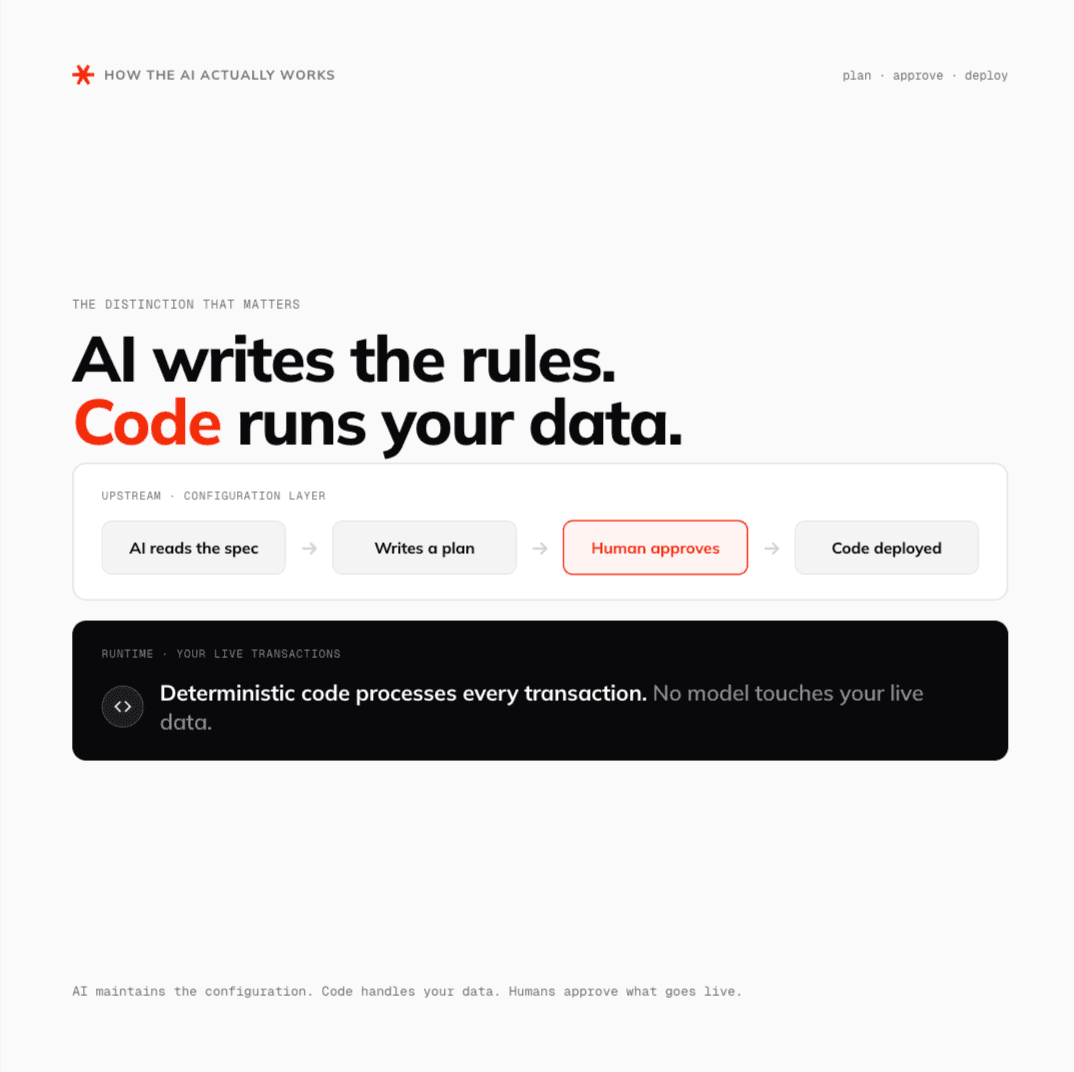
At transaction runtime, deterministic code processes your data. That code was written and validated by AI before it was deployed, but once it's deployed, it runs like any other code. There's no AI model making decisions about your live transactions as they flow through the system. The AI's job is upstream: it writes the rules. Code runs the transactions.
Every configuration change the AI proposes goes through a human review step before it executes. The AI produces a plan with a rationale. A human approves or rejects. Nothing reaches production without that step, and every action is logged. Not as a vague audit trail. With full reasoning for why the AI proposed what it proposed.
Access rights work the same way for the AI as they do for a human administrator. It can't touch anything a person couldn't touch manually through the platform.
The short version: AI maintains the configuration layer. Code handles your data. Humans approve what goes live.
Does Pricing Change When You're Using AI Features?
No. Orderful's pricing is flat, and the AI capabilities are built into the platform.
This is worth being direct about because it's genuinely different from how most of this industry works. When a retailer updates their spec and your managed service provider has to update your mapping, that cost lands somewhere, usually absorbed into your monthly support fee in a way that's not always visible. At Orderful, that work happens automatically. It's not a service event. It's not billed separately.
Adding a new trading partner doesn't trigger a change request or a consulting engagement. The AI capabilities that make that possible aren't a premium tier. They're just how the platform works.
A Few Things Worth Being Honest About
The transformation writing is fully in production. Guideline generation is active and improving, with quality tracking built in. The integration testing capabilities are live on active customer partnerships. The partner configuration automation has cleared internal testing but isn't customer-facing yet.
Current AI capabilities cover X12. EDIFACT is under active discussion and EDIFACT INVOIC outbound is in development, but there's no confirmed timeline. If that matters to your evaluation, ask before you sign.
The AI is not making real-time decisions on your live data. It is not changing your configurations without review. The plan-and-approve model is a real constraint, not a footnote in the security section.
If you have questions this didn't cover, reach out. We'd rather answer the uncomfortable question now than have you find out during implementation.
