

Compare Orderful and Cleo for EDI integration. Orderful delivers API-first architecture, avg 9-day partner onboarding, and flat-rate pricing.
Orderful and Cleo both process EDI. The difference is in what they are built on. Orderful is API-first from the ground up: every transaction is JSON, every connection is a REST API call, and every trading partner onboards from a shared standards library. That foundation changes what is possible for onboarding speed, pricing, and how cleanly EDI fits into your existing tech stack.
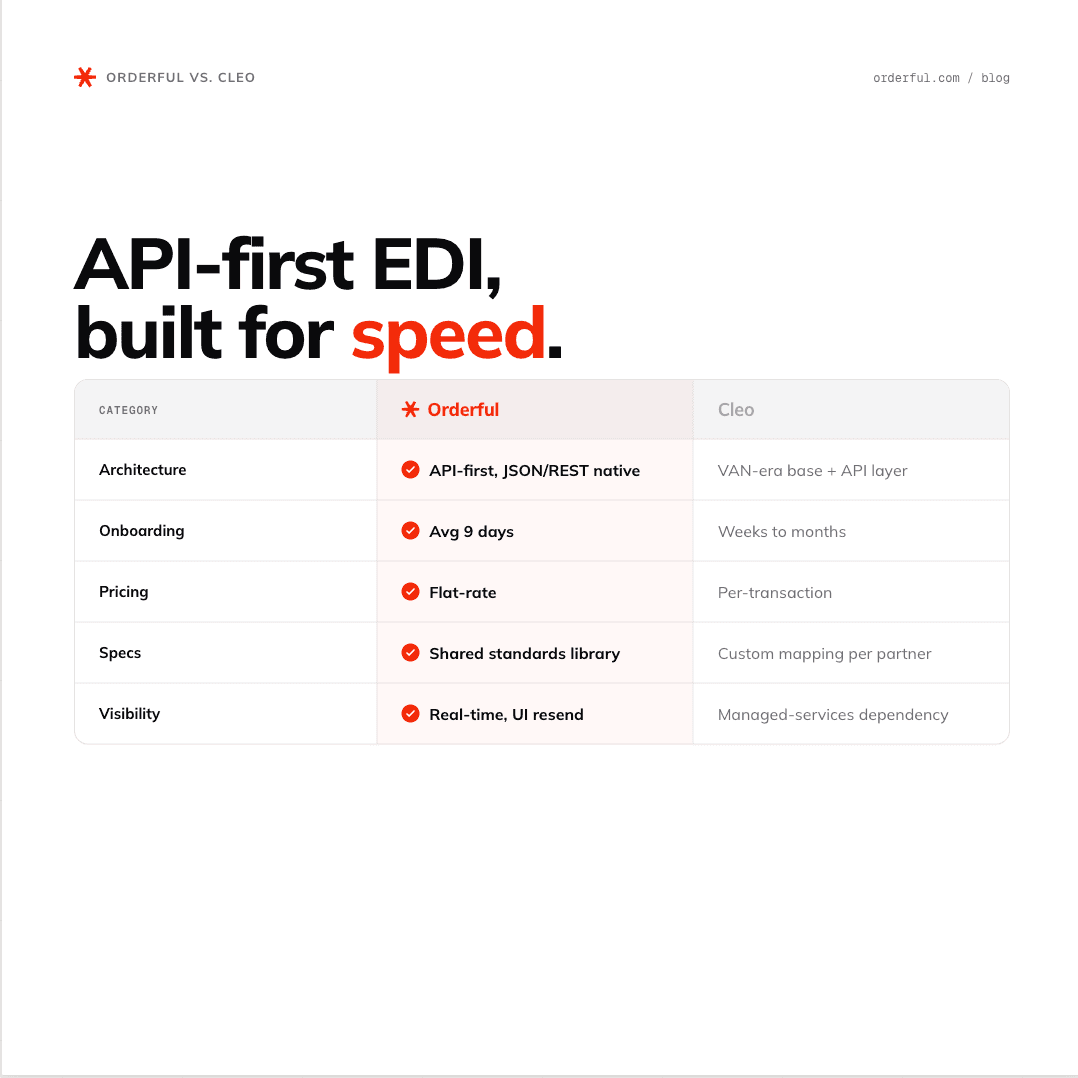
Category | Orderful | Cleo |
|---|---|---|
Architecture | API-first, JSON/REST native | VAN-era base with API layer added |
Trading partner onboarding | Avg 9 days | Weeks to months |
Pricing | Flat-rate, no per-transaction fees | Variable, per-transaction |
Spec management | Shared standards library | Custom mapping per partner |
ERP/WMS integration | Any REST API-capable system | Proprietary connectors required |
Transaction visibility | Real-time, UI resend | Managed services dependency |
Support model | Dedicated implementation team | Tiered, ticket-based |
Why Does EDI Onboarding Take So Long?
The short answer: custom mapping. Every time a legacy EDI setup onboards a new trading partner, someone has to translate that partner's spec into a proprietary format, build the map, run test cycles, and iterate on errors. When you are bringing on 20 or 50 partners, that work multiplies fast.
Orderful eliminates most of that through a shared standards library. Trading partners on the Orderful network connect to specifications that already exist and have already been validated. When your new retail customer is already on the network, there is nothing custom to build. Average onboarding time: 9 days.
For companies that manage large partner rosters or face retailer mandates on short timelines, that difference is the whole game.
What "API-First" Actually Means
A lot of EDI platforms use "API" in their marketing. Most of them mean they have added an API layer on top of a file-based VAN architecture. The underlying system still thinks in flat files, ISA envelopes, and batch processing. The API is a wrapper.
Orderful was built differently. Every transaction in Orderful is a JSON object. Your systems send and receive via REST API, the same way they connect to Stripe or Shopify or any other modern SaaS tool. There is no translation step between your stack and your trading partners.
What that means in practice:
Your ERP or WMS integrates with Orderful the same way it integrates with anything else
Your developers build against a real REST API with real documentation
When something goes wrong, you can see it in the UI and act on it without opening a support ticket
The Differences in Detail
Onboarding Speed
Orderful's shared standards library means most trading partner connections do not require custom spec work. Partners already on the Orderful network come with pre-built, validated specifications. New-to-network partners still onboard faster because the underlying standard transaction types (850, 856, 810, 855, 846) are already defined.
Legacy EDI setups require custom mapping for each trading partner, even when the transaction type is a standard X12 document. That per-partner work is why EDI onboarding historically takes months.
Pricing
Orderful charges a flat monthly rate. Transaction volume does not change your bill. When order volume spikes during peak season, your EDI costs do not.
Legacy EDI pricing typically ties cost to volume through per-transaction fees, per-document charges, or tiered pricing thresholds. Companies that grow fast or run high-volume seasonal peaks often discover this the hard way.
Spec Management
Trading partner specs in Orderful live in a shared library maintained across the entire network. When a spec changes, the update applies for everyone at once. You are not maintaining a library of per-partner files.
Legacy EDI setups maintain each partner's spec separately. When a retail partner updates their requirements, it triggers a new round of custom mapping work. At scale, this becomes a significant ongoing burden.
ERP and Backend Integration
Orderful connects to any system that speaks REST: NetSuite, Microsoft Dynamics 365, Odoo, Acumatica, Trimble, and others. No proprietary connectors, no middleware layer.
Legacy EDI setups often require proprietary connectors or additional middleware to bridge between the EDI layer and backend systems. That adds cost, a third-party vendor, and another integration to maintain.
Visibility and Control
Every transaction is visible in Orderful in real time. You can see the status of any 850, 856, or 810, track functional acknowledgments (997/999), and retry failed transmissions directly from the UI. No ticket required.
With legacy EDI setups, transaction visibility often depends on the support model. When troubleshooting requires a managed services team, every EDI issue creates a delay that extends downstream into order management and fulfillment.
Where Legacy EDI Setups Create Problems
When companies move to Orderful, they are usually dealing with one or more of the same patterns.
Onboarding backlogs. Every new trading partner becomes a project. IT estimates weeks. Sales promises months. Operations waits. The bottleneck is not the standard: it is the custom work every legacy integration requires.
Peak-season pricing surprises. EDI costs that scale with transaction volume hit hard during the holidays or a major product launch. Flat-rate pricing removes that variable from the equation.
Integration debt. When the EDI layer does not speak REST natively, every connection to a backend system becomes a custom project. Over time, companies accumulate a stack of file-based integrations, translation scripts, and manual processes that nobody fully understands.
Support as a bottleneck. When you cannot see your own transaction data without opening a ticket, the EDI support team becomes a dependency in your order management process. Companies that need to move fast cannot operate that way.
Why Teams Choose Orderful
1. Onboard Partners in Days, Not Months Orderful's network has 1,000+ pre-connected trading partners. When your new retail customer is already on the network, their spec is already built and validated. Average time to a live connection: 9 days.
2. Flat-Rate Pricing One monthly rate. No per-transaction fees. No per-document charges. No VAN costs. When your business grows or peak season hits, your EDI bill stays flat.
3. Built for Developers Orderful is a REST API. Every transaction is JSON. Your team builds against real documentation using real tools. Integrating Orderful into your ERP is the same as integrating any other API.
4. Real-Time Transaction Visibility See every transaction, track partner acknowledgments, and retry failed transmissions from the Orderful platform. No managed services dependency, no ticket queue for basic visibility.
5. A Network, Not Just Software Orderful is both the platform and the network. Trading partners connect directly. When your partner is already on Orderful, there is nothing to configure on their end either.
6. A Dedicated Implementation Team Every customer gets a dedicated implementation team. Average time from contract to first live transaction: 9 days.
What Orderful Customers Say
"We went from a 90-day EDI onboarding process to single-digit days. The difference is the network: when a trading partner is already on Orderful, there is almost nothing to do." Operations Lead, Mid-Market Retail Brand
"Flat-rate pricing was a big part of the decision. We have some very high-volume partners. Knowing our EDI costs are fixed regardless of volume changes how we think about partner onboarding." VP of Technology, Consumer Goods Company
Frequently Asked Questions
Is Orderful a good alternative to Cleo for EDI?
Orderful is a strong fit if you are prioritizing onboarding speed, pricing predictability, and a clean API integration model. Orderful's flat-rate pricing and shared standards library are a different approach from traditional EDI providers. The best fit depends on your partner volume, integration complexity, and how your team wants to manage the EDI layer.
How long does it take to onboard a trading partner on Orderful?
The average is 9 days. When a trading partner is already connected to the Orderful network, spec work is minimal or zero. For new-to-network partners, Orderful's shared standards library still compresses onboarding significantly compared to custom-mapping-based setups.
Does Orderful work with NetSuite, Dynamics 365, or other ERPs?
Yes. Orderful connects to any ERP or WMS that supports REST APIs: NetSuite, Microsoft Dynamics 365, Odoo, Acumatica, Trimble, and others. No proprietary connectors or middleware required.
What EDI transaction types does Orderful support?
Orderful supports the full range of ASC X12 and EDIFACT transaction sets, including 850 (purchase order), 856 (advance ship notice), 810 (invoice), 855 (PO acknowledgment), 846 (inventory inquiry), and 997/999 (functional acknowledgments).
How does Orderful's pricing compare to Cleo?
Orderful charges a flat monthly rate with no per-transaction fees. Traditional EDI pricing typically scales with transaction volume. For companies with high or variable order volumes, that difference is significant, particularly during peak seasons.
Can I switch from Cleo to Orderful?
Yes. Orderful's implementation team has migrated customers from legacy EDI providers. Your dedicated team handles the transition, and existing trading partner connections are typically rebuilt on the Orderful network faster than the original implementation took.
Ready to See the Difference?
If you are spending months on EDI onboarding, paying per-transaction fees, or waiting on a support ticket to see your own transaction data, there is a faster way.
