

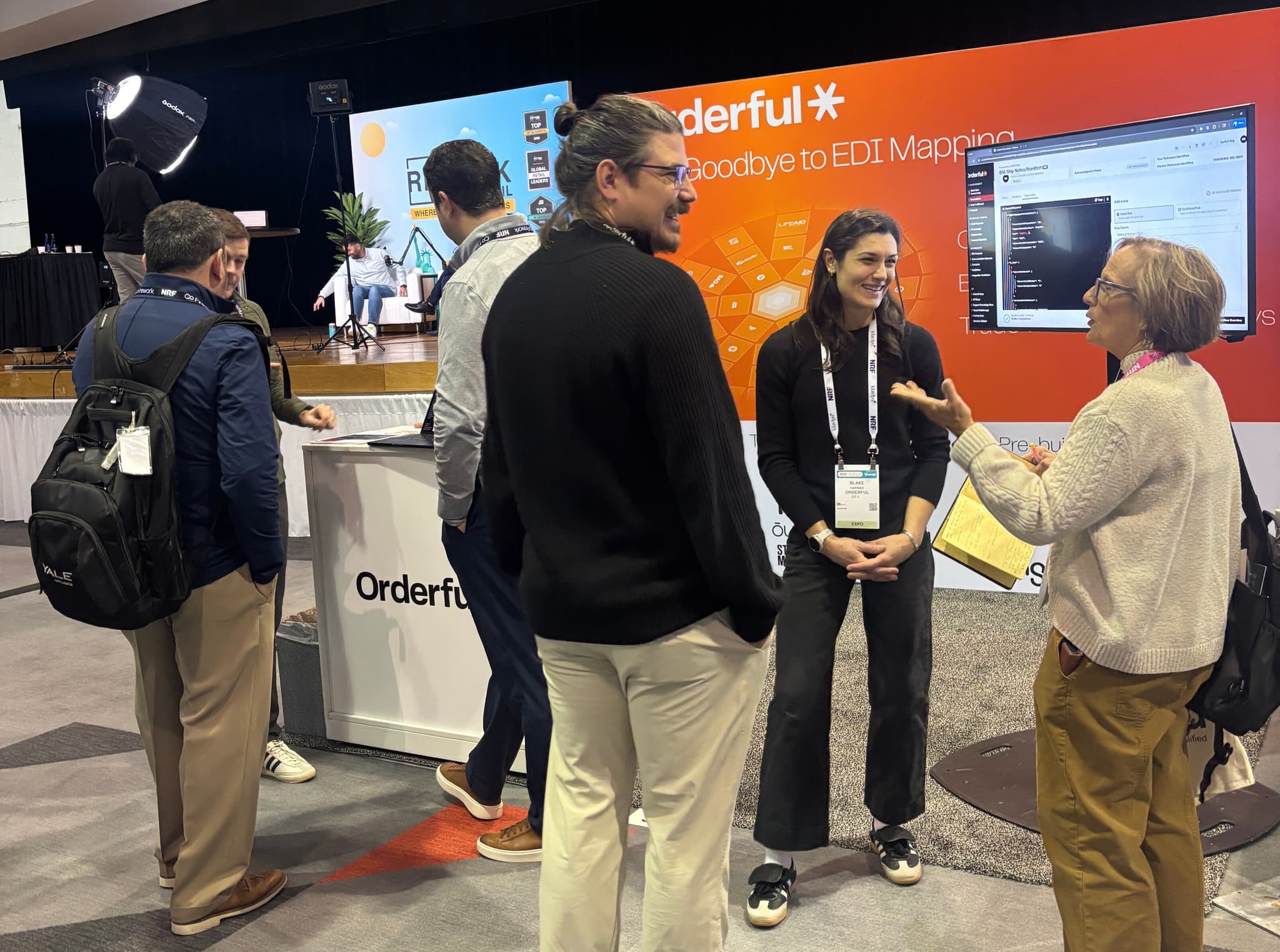
Across hundreds of conversations at NRF 2026, patterns emerged about where retail operations are actually headed. These four shifts stood out as the most critical for how retailers, brands, and suppliers will need to operate moving forward.
Retail is in a strange place right now. On one hand, consumers keep spending and new brands keep entering the market. On the other, operational complexity has never been higher. More partners, more channels, more data, and less tolerance for friction.
That tension was on full display at this year’s National Retail Federation Retail Big Show. Across conversations with retailers, brands, and technology leaders, one thing became clear. Retail is not slowing down to regain control. It is learning how to operate in motion.
The focus has shifted from doing more to doing better, especially when it comes to how systems, partners, and processes connect.
Here are four shifts we believe matter most right now.
1. AI Has Officially Moved From “Interesting” to “Operational”
AI was everywhere at NRF, but not in the way it was even a year ago.
What stood out was not the novelty of the tools. It was the tone of the conversations. Retailers are no longer asking if they should adopt AI. They are asking who they can trust to put it into production without introducing risk.
That shift matters. Unlike previous generations of enterprise software, where adoption was about training people to click the right buttons, AI introduces a different challenge. Teams must learn how to trust automated decisions, understand why recommendations are being made, and know when human judgment should step in.
Across customer insights, support, inventory management, and data analysis, AI agents are increasingly responsible for interpreting information and taking action. That puts pressure on the quality of the data flowing through these systems. Automation only works when the foundation underneath it is clean, accurate, and consistently translated across partners.
This is also where expertise becomes non-negotiable. AI does not replace domain knowledge. It amplifies it. The teams seeing real results are pairing intelligent automation with people who deeply understand retail operations, compliance requirements, and partner variability, not just the technology itself.
That reality was reinforced in a very tangible way at NRF, when Orderful received the Vendor in Partnership Challenge Award at the group’s NRF gala.
The recognition stemmed from work with Every Man Jack, a brand migrating off legacy systems while scaling rapidly and restoring fulfillment performance. What stood out was not flashy innovation. It was how modern technology, paired with deep technical expertise, removed friction that had long been accepted as the cost of doing business. Faster onboarding, fewer errors, and real-time visibility fundamentally changed how the business operated day to day and allowed company leadership to make operational decisions in the timelines they needed.
It was a reminder that AI is at its best when it quietly makes complex processes feel simple.
2. The Physical Retail Experience Is Getting Smarter, Not Smaller
Despite years of predictions about the end of brick-and-mortar, NRF made one thing clear. Physical retail is not going anywhere.
AR and VR experiences are becoming more viable each year, not as gimmicks, but as practical tools for guided shopping, personalized discovery, and immersive product storytelling. As wearables and in-store technologies mature, retailers are finding new ways to layer digital context into physical spaces.
At the same time, RFID and smart labeling are reaching an inflection point. What was once limited to warehouses is now moving closer to the product itself, sometimes down to the individual item.
This unlocks new possibilities. These include real-time inventory accuracy, improved demand planning, better loss prevention, and deeper insight into how products move from manufacturing to resale. For consumers, it means transparency, proof of authenticity, traceability, and confidence in what they are buying.
Behind the scenes, this evolution raises the bar. When every item can tell a story, the systems connecting suppliers, brands, and retailers have to stay aligned. The physical world is moving faster, and the digital backbone has to keep pace.
3. Supply Chains Are Being Orchestrated, Not Rebuilt
One of the most consistent frustrations we heard at NRF was ERP fatigue.
Retailers know their systems are not perfect, but ripping and replacing core platforms is expensive, disruptive, and risky. Instead, a more pragmatic approach is emerging. Teams are layering intelligence on top of existing systems to better connect internal and external data.
New supply chain orchestration platforms are doing exactly that. They use cloud technology and AI to tie together buyers, suppliers, logistics partners, and service providers without forcing a wholesale overhaul.
This shift matters because retail does not operate in isolation. Every new brand, supplier, or channel introduces complexity. The companies navigating this well are not chasing one system to solve everything. They are focused on creating flexibility between systems so information can move reliably across the network.
From our perspective, this is one of the most encouraging signals in retail technology. It reflects a growing understanding that resilience comes from adaptability, not rigidity.
4. Constraints Are Fueling Creativity Across Retail
The macro environment remains complex. Tariffs, rising material costs, and global uncertainty have not stopped consumers from spending. However, they have changed how brands operate.
Larger brands are leaning into buying power and scale. Smaller and emerging brands are taking a different path. They are experimenting with alternative suppliers, non-traditional materials, and more focused product assortments. In many cases, these constraints have become part of the brand story itself.
At the same time, recycle, up-cycle, and resell markets continue to accelerate. Consumers are more value-conscious, but they are also more skeptical of knockoffs and waste. Authenticity, transparency, and traceability are no longer nice to have.
Retail still represents a defining milestone for these brands. For all the success of direct-to-consumer, landing on a retail shelf remains a powerful signal of credibility and scale. Retailers that curate diverse, differentiated brand portfolios are becoming destinations, not just distribution points.
What ties all of this together is visibility. As supply chains become more transparent, every participant, from raw material suppliers to manufacturers to retailers, has an opportunity to differentiate based on how they operate, not just what they sell.
Final Takeaway
NRF this year did not feel like a show about chasing trends. It felt like a checkpoint, a moment where retail collectively acknowledged that complexity is not going away, but it does not have to be painful.
The brands and retailers pulling ahead are not adopting the most tools. They are building trust in their systems, clarity in their data, and flexibility in how they connect with partners.
From where we sit, that is not just encouraging. It is exactly where retail needs to be headed.
